Upgrading n8n v1 to v2: Seven Deprecations in One Log File
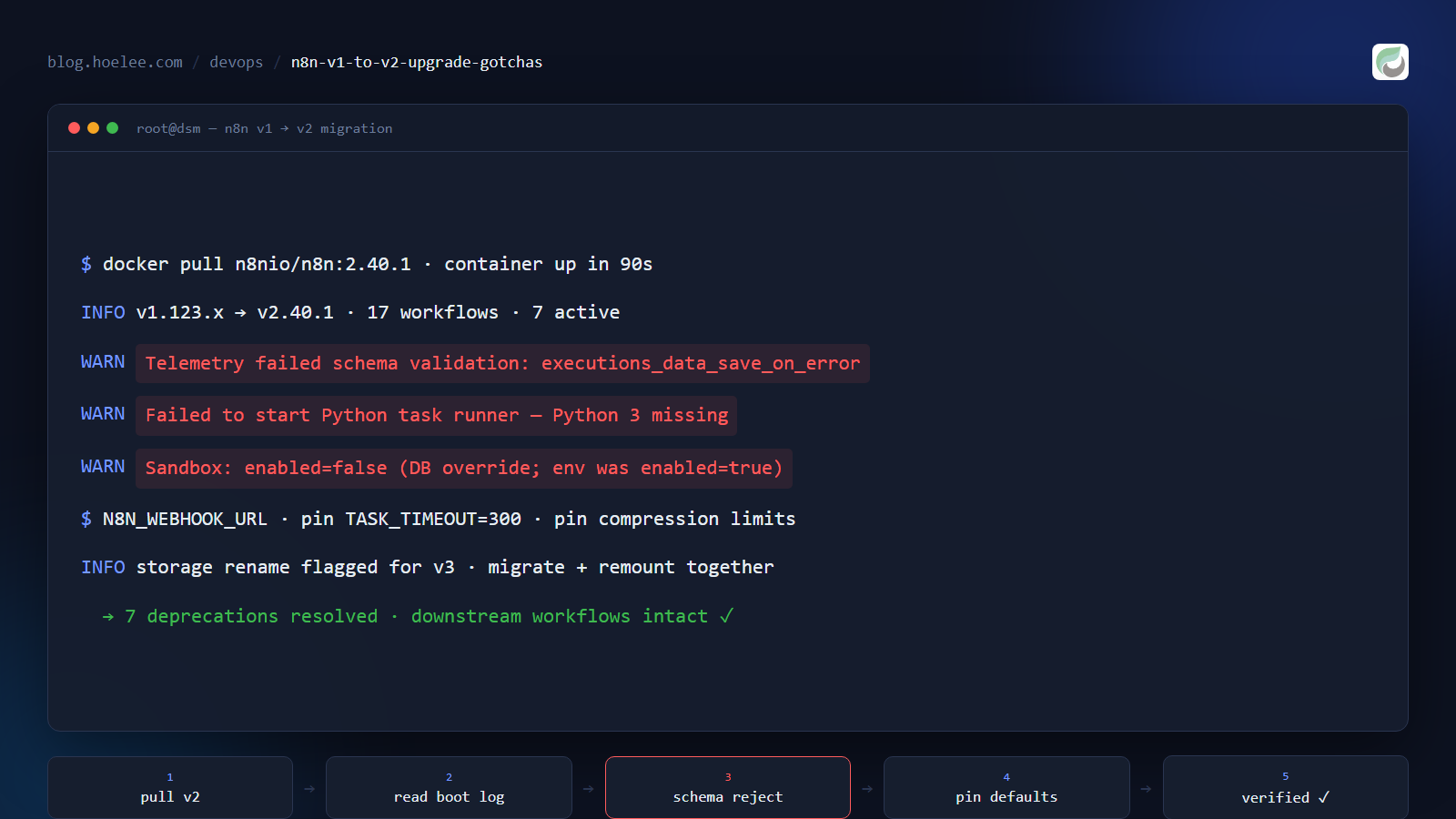
I run n8n as the automation backbone for my self-hosted stack — it handles
file-delivery permissions, database backups, and a text-to-speech API that a
reading app depends on. It had been sitting on the 1.123.x line for the
better part of a year, quietly doing its job.
Then I pulled n8nio/n8n:2.40.1 and restarted the container. The upgrade
itself took about ninety seconds. Understanding what it broke took the rest
of the evening — and almost all of it was already written down in a single log
file that n8n prints on boot. I just hadn’t read it carefully enough the first
time.
This is that log file, decoded, so you can plan your own v1 → v2 jump instead of discovering these at 11 PM.
Why it matters
Major-version upgrades of an automation platform are different from upgrading a leaf service. n8n is the thing that runs everything else: if it comes up broken, your backups, your access-control syncs, and your internal APIs all stop with it. Worse, most of what breaks in v2 doesn’t throw an error — it logs a deprecation notice once and then quietly does something different.
The seven items below are the ones that actually applied to a real, messy, production-shaped install. Three of them changed behavior in my stack. One of them silently turned a feature off.
Start here: n8n tells you what’s wrong at boot
Before touching a single workflow, read the container log from the top. On a fresh v2 boot, n8n prints an explicit deprecation block:
There are deprecations related to your n8n setup. Please take the recommended
actions to update your configuration:
 - WEBHOOK_URL -> Use N8N_WEBHOOK_URL instead, which sets the base URL for
   both test and production webhooks.
 - N8N_UNVERIFIED_PACKAGES_ENABLED -> The default for this variable will
   change to `false` in a future version.
 - N8N_RUNNERS_MODE -> Internal task runner mode is deprecated and will be
   removed in a future version.
 - N8N_RUNNERS_TASK_TIMEOUT -> The default for this variable will be reduced
   from 300 (5 minutes) to 60 (1 minute) in a future version.
 - N8N_COMPRESSION_NODE_MAX_DECOMPRESSED_SIZE_BYTES -> The default will be
   reduced from 2 GiB to 256 MiB in a future version.
 - N8N_COMPRESSION_NODE_MAX_ZIP_ENTRIES -> The default will be reduced from
   5000 to 1000 in a future version.
That block is your migration checklist. Six of my seven gotchas are in it.
1. Your env values can now fail schema validation
Here is the one that confused me most, because it looked like a nonsense error:
Telemetry event "Instance started" failed schema validation:
execution_variables.executions_data_save_on_error: Invalid option:
expected one of "all"|"none"
I had EXECUTIONS_DATA_SAVE_ON_ERROR=error set — a value that was perfectly
legal in v1, and that I’d chosen deliberately, because saving only failed
executions is the sane default for a busy instance. In v2 that value is no
longer in the allowed set, which is now all or none.
The failure mode is the interesting part. It didn’t crash. It didn’t even warn in a way that reads like an error at a glance — it emitted a telemetry schema validation message, which sounds like an n8n-internal problem, not a configuration problem of mine. The setting was effectively ignored.
The fix is to move that intent somewhere coherent: pick a legal value and control volume with pruning instead.
EXECUTIONS_DATA_SAVE_ON_ERROR=all
EXECUTIONS_DATA_SAVE_ON_SUCCESS=none
EXECUTIONS_DATA_PRUNE=true
EXECUTIONS_DATA_MAX_AGE=336
EXECUTIONS_DATA_PRUNE_MAX_COUNT=10000
Lesson: in v2, treat your environment variables as a typed interface with a schema. An invalid value may be dropped silently rather than rejected loudly.
2. WEBHOOK_URL is deprecated for N8N_WEBHOOK_URL
If you publish webhooks behind a reverse proxy — which you almost certainly do,
because that’s how they become reachable — the base URL variable is load-bearing.
It’s what makes n8n report the public webhook path instead of
http://localhost:5678/....
The old name still works today, so this one won’t bite immediately. But note the wording: the new variable sets the base URL for both test and production webhooks. In my setup those had drifted apart in behavior, which is exactly the class of bug this consolidation is meant to eliminate.
# before (still functional, deprecated)
WEBHOOK_URL=https://auto.example.com/

# after
N8N_WEBHOOK_URL=https://auto.example.com/
3. Internal task runner mode is going away — and mine was already broken
This one was sitting in my logs the whole time, several lines above the deprecation block, and I’d been reading past it for months:
Failed to start Python task runner in internal mode. because Python 3 is
missing from this system. Launching a Python runner in internal mode is
intended only for debugging and is not recommended for production.
If any workflow of yours uses a Python Code node, it has not been running in internal mode at all — there’s no Python in the stock image. JavaScript Code nodes are fine (a JS runner registers normally), which is why this can go unnoticed indefinitely: everything looks healthy.
v2 makes the direction of travel explicit: switch to external mode and share
an auth token with a separate launcher process.
N8N_RUNNERS_MODE=external
N8N_RUNNERS_AUTH_TOKEN=<a long random string>
Lesson: “internal mode is deprecated” is the headline, but the real
finding is that a runner type can be silently non-functional for months.
Check docker logs for the runner registration line, not just for up/down.
4. Task timeout drops from 300s to 60s
This is the one I’d flag hardest for anyone with slow workflows:
N8N_RUNNERS_TASK_TIMEOUT -> The default for this variable will be reduced
from 300 (5 minutes) to 60 (1 minute) in a future version.
Be honest about your own workloads. Do you have a Code node that loops over thousands of records, or an HTTP call to a slow upstream? Mine do — a nightly reconciliation walks every customer and calls an external API per record. On a future upgrade, that stops at sixty seconds with no config change on my side.
Set it explicitly now, while you’re already in the file:
N8N_RUNNERS_TASK_TIMEOUT=300The general principle for every deprecation of the form “the default will change”: if you rely on the current default, pin it explicitly. Otherwise the upgrade is a silent behavior change, and you’ll debug it as a bug rather than recognise it as a stale default.
5 & 6. Two compression-node limits shrink (2 GiB → 256 MiB, 5000 → 1000 entries)
These two travel together and matter only if you use compression/decompression nodes on large payloads — which is easy to end up doing when you’re shuttling database dumps or archives through a workflow.
N8N_COMPRESSION_NODE_MAX_DECOMPRESSED_SIZE_BYTES -> reduced from 2 GiB to
256 MiB in a future version.
N8N_COMPRESSION_NODE_MAX_ZIP_ENTRIES -> reduced from 5000 to 1000 in a
future version.
An eighth of the memory ceiling and a fifth of the entry limit. Nothing errors; the node just refuses at a threshold you didn’t set. Pin both if you’re near either.
7. The storage path renames in v3 — and you have a volume mounted at the old one
Not a v2 breakage, but v2 warns about it, and it’s the one with real data-planning implications:
Deprecation warning: The storage directory "/home/node/.n8n/binaryData" will
be renamed to "/home/node/.n8n/storage" in n8n v3. To migrate now, set
N8N_MIGRATE_FS_STORAGE_PATH=true. If you have a volume mounted at the old
path, update your mount configuration after migration.
Read that last sentence again: if you have a volume mounted at the old path, update your mount configuration after migration. If you set the migration flag and keep your old bind mount, you now have two directories and your binary data lives in whichever one the container is actually pointed at. Do the rename and the mount change in the same maintenance window — not one now, one “later”.
The one that wasn’t in the log: my AI sandbox disabled itself
Here’s the finding that had nothing to do with a deprecation notice, and that I’d never have caught without reading the full boot sequence:
Sandbox: enabled=false provider=n8n-sandbox (DB override; env was enabled=true
provider=n8n-sandbox)
My environment said enabled. The database said otherwise. The database won.
The env var was N8N_INSTANCE_AI_SANDBOX_ENABLED=true, and it was still set
correctly on the container. But a value persisted in n8n’s own configuration
store overrode it at startup — and the only place that conflict is reported is
inside a parenthetical in a log line.
This is a genuinely valuable debugging lesson beyond n8n: when a feature is off despite the env var being obviously right, suspect a persisted settings layer that outranks your environment. The container config is not always the last word. Grep for the feature name in the logs, and don’t stop at the env value.
What I’d do differently
- Read the boot log before declaring the upgrade done. Every deprecation that mattered to me was printed on startup, in one block, on the first run. My v1 habit was to check “is it up, do the workflows run” — which is exactly the check that misses all seven of these.
- Treat “the default will change” as a to-do, not a warning. Five of the seven items are future-default changes. Pinning them now costs one edit and converts a mystery outage later into a config diff.
- Diff the container config against n8n’s own stored config. The sandbox override taught me that env is one of two inputs, not the source of truth. When behavior and configuration disagree, believe the behavior and go find the higher-priority layer.
- Pin the image tag and keep the previous one. I jumped v1 →
2.40.1directly. Having the old image on disk is what makes a rollback adocker runinstead of a rebuild.
The result
n8n is on 2.40.1 with the full deprecation block resolved: the schema-invalid
value corrected, N8N_WEBHOOK_URL in place, the JS runner registering cleanly,
and the task timeout and compression limits pinned so the next upgrade is a
no-op rather than a surprise.
Everything downstream kept working — the file-permission syncs, the nightly backups, the text-to-speech endpoint. That’s the outcome worth aiming for with an upgrade like this: not “it came back up”, but “it came back up and the next three upgrades are already paid for”.
The uncomfortable part is how much of it I could have known in advance. n8n handed me the entire list, unprompted, at startup. The upgrade was never the hard part — reading the output was.
Running automation you’d rather not babysit?
I build and maintain self-hosted automation — n8n workflows, Docker stacks, and the glue between apps that were never designed to talk to each other. If you’re facing a major version upgrade, or you have automation that works until it doesn’t, I plan the migration, do it in a maintenance window, and document every config decision so the next upgrade is boring.
Reach me at [email protected] or WhatsApp +60 12-797 2969, or see what I do at hoelee.com.