Automating CyberPanel Without the UI: Reverse-Engineering an Undocumented v2 API
I run CyberPanel 2.4.4.1 inside an Ubuntu VM on my home lab to host a handful
of small sites. It sits at https://panel.hoelee.com, reverse-proxied to an
internal box. Recently I wanted to script two things against it — list my
sites and delete one — without opening the browser. This is the story of
finding that the “official” API doesn’t exist anymore, and reverse-engineering
the real one from what the Angular UI quietly calls under the hood.
The problem: the documented API is gone
Every search result, the Apiary docs, and the Knowledge Base point you at the
same thing — a JSON API where you POST your adminUser and adminPass to
/api/verifyConnection:
# What the old docs tell you to do. This does NOT work on CyberPanel v2.
curl -k -X POST https://panel.hoelee.com:8090/api/verifyConnection \
  -d '{"adminUser":"admin","adminPass":"...","serverUserName":"..."}'
On CyberPanel v2 (2.4.x), this returns nothing useful. The /api/ prefix is
the legacy surface — it was dropped. There’s no adminUser/adminPass
exchange anymore. The official documentation is simply out of date, which is
the first trap: you can spend a long time trusting docs that describe a
version you’re not running.
What I tried, and why it failed
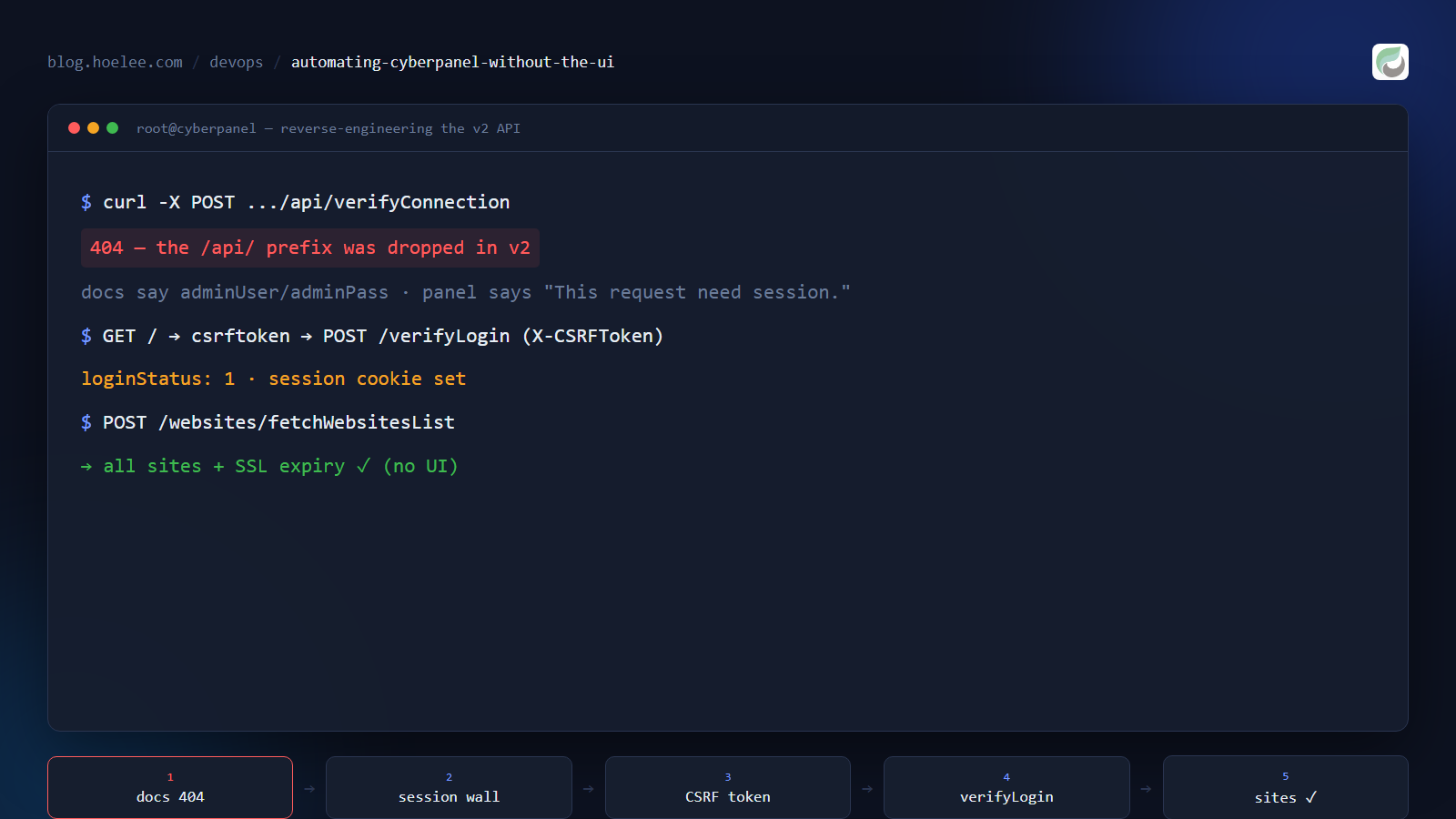
Attempt 1 — trust the docs. POST /api/verifyConnection with credentials,
exactly as Apiary says. Result: 404. The route doesn’t exist.
Attempt 2 — hammer the obvious paths. I tried /api/, /verifyLogin with
an email field, a bare GET on a few guesses. I got back a response I kept
misreading:
"This request need session."That message is actually good news — it means the API is mounted and reachable, it just refuses to talk without a valid session. The endpoint isn’t missing; the auth is different.
Attempt 3 — the CSRF wall. I finally sent the right fields to
/verifyLogin and hit a hard 403 Forbidden. That’s the part that stalls
most people: POSTs to a Django-backed panel are protected by a CSRF token, and
a bare JSON POST with no token gets dropped before your credentials are even
looked at.
The breakthrough was treating the panel not as “a thing with an API” but as a Django app with an Angular front-end — and then just watching what the front-end sends.
The fix: the real auth flow
The whole thing is three steps, all with plain curl (and -k since the
panel uses a self-signed cert):
1. Grab the CSRF token from the login page
Django sets a csrftoken cookie on the very first GET. That cookie’s value is
the token you echo back in a header on every write:
curl -sk -c /tmp/cp_cookies.txt "https://192.168.1.124:8090/" -o /dev/null
CSRF=$(grep csrftoken /tmp/cp_cookies.txt | awk '{print $7}')
2. Log in to get a session cookie
POST /verifyLogin with a JSON body and the CSRF token in an X-CSRFToken
header:
curl -sk -b /tmp/cp_cookies.txt -c /tmp/cp_cookies.txt \
  -X POST "https://192.168.1.124:8090/verifyLogin" \
  -H "Content-Type: application/json" \
  -H "X-CSRFToken: $CSRF" \
  -H "Referer: https://192.168.1.124:8090/" \
  -d '{"username":"admin","password":"...","languageSelection":"EN","twofa":""}'
# => {"userID": 1, "loginStatus": 1, "error_message": "None"}
loginStatus: 1 means the session cookie is now valid. The Referer header
matters more than you’d expect — some of these views check it.
3. Call the data endpoints
The “API” is just the same POST endpoints the Angular UI calls.
/<module>/<function>, same cookie jar, same X-CSRFToken + Referer:
curl -sk -b /tmp/cp_cookies.txt \
  -X POST "https://192.168.1.124:8090/websites/fetchWebsitesList" \
  -H "Content-Type: application/json" \
  -H "X-CSRFToken: $CSRF" \
  -H "Referer: https://192.168.1.124:8090/" \
  -d '{"page":1,"recordsToShow":50}'
That returned every one of my sites, with SSL status, disk usage, PHP version, and per-site days-until-cert-expiry. The same pattern deletes a site:
curl -sk -b /tmp/cp_cookies.txt \
  -X POST "https://192.168.1.124:8090/websites/submitWebsiteDeletion" \
  -H "Content-Type: application/json" \
  -H "X-CSRFToken: $CSRF" \
  -H "Referer: https://192.168.1.124:8090/" \
  -d '{"websiteName":"blog.hoelee.com"}'
The two gotchas that ate most of the time
1. The 404 on /api/... was never a network problem — it was the wrong era.
The /api/ prefix belongs to the old API. Modern CyberPanel uses
root-relative /<module>/<function> with no /api/ segment. Once I stopped
looking for an “API” and started looking for the UI’s own routes, everything
snapped into place.
2. List responses are double-encoded JSON. fetchWebsitesList returns
something shaped like:
{ "data": "[{\"domain\":\"...\",\"ssl\":{\"days\":17}, ...}]" }The data key is a JSON-encoded string, not an array. If you pipe it
straight into jq and try .[], you get nothing sensible. You have to unwrap
one layer first:
curl ... | jq -r .data | jq # unwrap the string, then parse againHow to find the other endpoints
The function names aren’t random — they map directly to Django view functions
in the CyberPanel source (usmannasir/cyberpanel on GitHub, stable branch).
The relevant files are websiteFunctions/views.py, mailFunctions/views.py,
manageSSL/views.py, and so on. So the workflow is:
- Find the page in the UI (say, “Create Website”).
- Open the browser’s network tab and watch what URL it POSTs to — or grep the
matching
views.pyfor the view name. - Call the same
/<module>/<function>path with your session + CSRF headers.
A useful distinction: a GET /<module>/<page> usually returns the HTML of
the UI page, while the data comes from a POST to a sibling function. If
you GET a page and get markup back, you haven’t found the real endpoint yet —
keep looking for the AJAX call.
What I’d do differently
- Start from the front-end, not the docs. Watching the Angular app’s network requests would have saved me the whole “trust the obsolete Apiary docs” detour. The UI is always the ground truth for its own API.
- Treat “This request need session.” as a beacon, not an error. The first few times I read it as “wrong endpoint” when it was really “right endpoint, wrong session state.”
- Script the login once into a reusable helper. The session cookie dies
on VM reboot and on expiry, so every one-off
curlstarted from scratch. A tiny wrapper that logs in, captures the cookie, and re-logins on"This request need session."would have made the whole session repeatable instead of exploratory.
The result
I can now list, create, and delete sites on my CyberPanel panel entirely from
the shell — no browser, no GUI — and the whole authenticated API surface is
open for scripting (SSL, mail, DNS, cron). I found this by scrapping the docs,
watching the real requests, and mapping them back to their Django views, and
the cyberpanel module + session flow now lives in my own automation toolkit.
The broader lesson: “it’s not documented” rarely means “it’s not possible.” When a tool exposes a web UI, that UI is a living, exact reference for the API — you just have to watch what it actually sends.
Want your server administration scripted?
If you’re clicking through a hosting panel — or worse, doing the same manual steps across several servers — I automate exactly this kind of thing: turn repetitive admin into a tested script or a small internal tool, wired to your existing stack, with a handover so you’re never locked in. Whether it’s CyberPanel, cPanel, Docker, or a bespoke dashboard, if it has a web UI, it can almost certainly be driven without one.
Reach me at [email protected] or WhatsApp +60 12-797 2969, or see what I do at hoelee.com.