Authentik 2025.8 to 2026.8: The Breakable Parts Nobody Warns You About
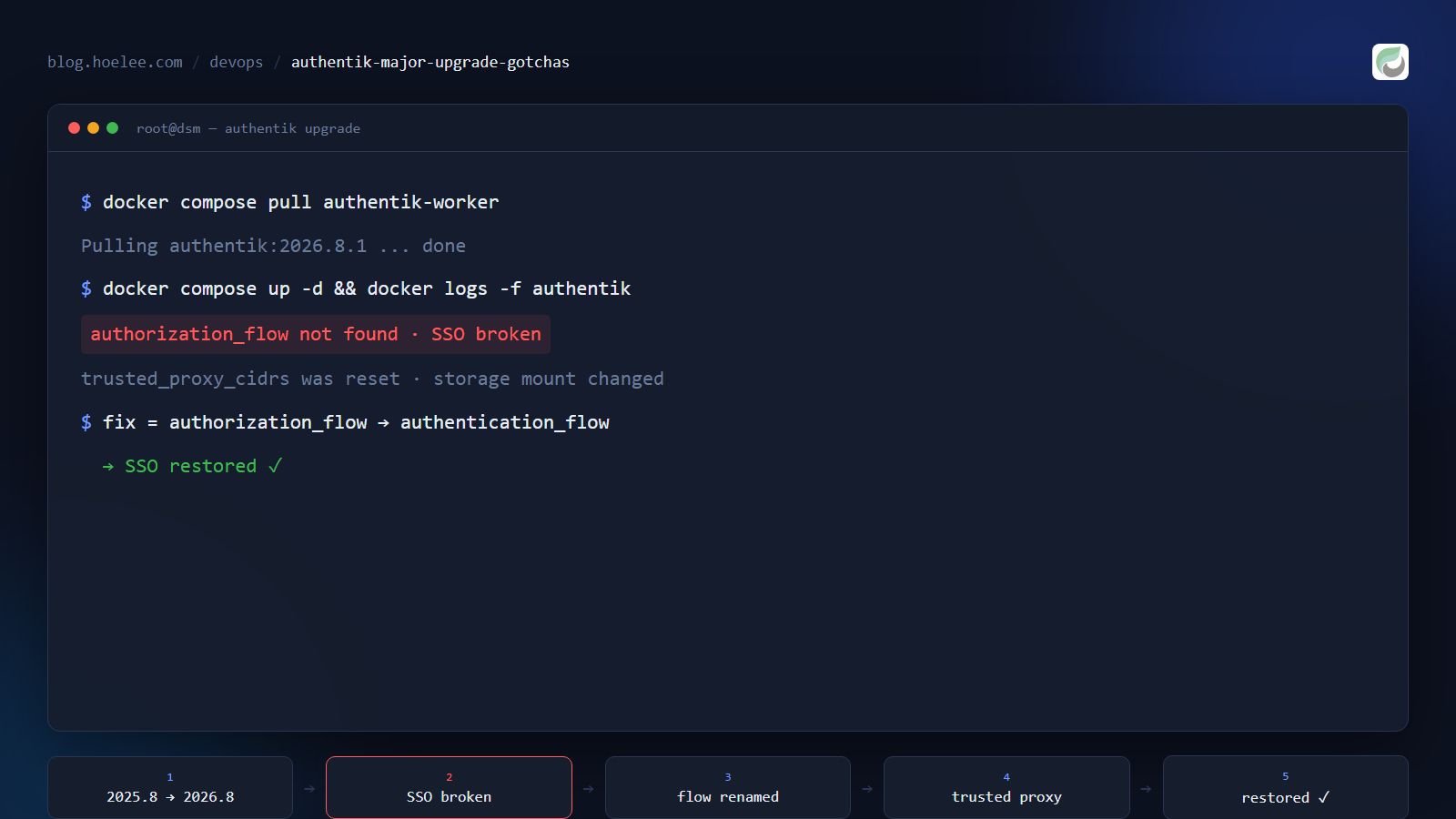
I run authentik as the single sign-on gate in front of my self-hosted stack — email, dashboard, Synology apps, a remote-access outpost. For a long while it sat on 2025.8.3, and a year of releases piled up. This is the story of bringing it all the way to 2026.8.1 in one sitting, and everything that broke along the way — especially the one mistake that took Single Sign-On completely offline and made every internal app ask for a password again.
What is authentik, and why run it?
authentik is an open-source identity provider (IdP) — the thing that answers one question over and over: “who is this person, and are they allowed in?” Think of it as the front door to a whole building of apps. Instead of every app running its own username/password screen (and its own list of bugs, its own “forgot password” flow, its own 2FA), you make all of them ask authentik instead.
It speaks the protocols that matter for real deployments:
- OIDC / OAuth2 — the modern single sign-on standard (what “Sign in with Google” uses under the hood).
- SAML — the enterprise standard (for tools like Grafana, Jira, or any legacy line-of-business app).
- LDAP — so older clients and NAS boxes that only know LDAP can join too.
- Proxy / forward-auth — it sits in front of an app via a reverse proxy and gatekeeps access before a request ever reaches the app.
The practical benefits, in order of how much they actually matter:
- One login for everything. Log in once, move freely between every app. Users stop juggling a dozen passwords (and the support tickets that go with them).
- One place to lock things down. MFA, password policy, session limits, and account recovery live in authentik once — not re-implemented per app.
- One place to audit. Every login, on every app, for every user, in one log. That’s the difference between “we think nothing happened” and “we can prove it” when a question comes up.
- Self-contained and self-hosted. You own the data. No per-user SaaS fees that scale with your headcount, no lock-in — it’s AGPL, runs in Docker.
For a small business or a solo operator running twenty-something services (email, dashboards, NAS apps, internal tools), authentik is the difference between “every app has its own flimsy password” and “one hardened front door.”
Why upgrade at all
Version 2025.8.3 wasn’t broken. But it had fallen far enough behind that a stack of CVEs had landed in the releases after it, and I was getting ready to do per-application branding. authentik’s own policy is that you can’t jump major versions — it enforces a stepwise path. So the plan was:
2025.8.3 → 2025.10 → 2025.12 → 2026.2 → 2026.5 → 2026.8Six hops, one at a time, with a migration and a health-check between each. Before touching anything, the one non-negotiable step: back up the database. authentik doesn’t support downgrades. If a migration half-runs, you’re restoring from dump, not rolling back an image tag.
sudo docker exec authentik-postgres pg_dump -U authentik authentik > authentik-backup.sqlPitfall 1: Portainer is the source of truth, not the compose file
My first instinct was to edit the docker-compose.yml on disk and up it.
Wrong. The stack is managed by Portainer (stack 143), which keeps the real
compose and the real environment variables in its own store. The .env on disk
was stale — its PG_PASS didn’t match what Portainer actually ran.
The correct update path is via the Portainer API, not the filesystem:
- Update the image tags in the compose content.
docker pullthe new images first (so the API call doesn’t time out mid-pull).docker stop+docker rmthe running containers (fixedcontainer_namewill otherwise collide on redeploy).PUT /api/stacks/143?endpointId=2with the newStackFileContent+Env.
I hit the colliding-container error, the pull-timeout error, and a network-attach
problem where the rebuilt authentik-server only joined one of its two networks
and couldn’t resolve postgres-server. Each one is a five-minute fix once you
know what you’re looking at, but together they ate the better part of the evening.
Pitfall 2: the storage mount moved (2025.12)
Up to 2025.12, brand assets lived under /media/ and were served at /media/....
After 2025.12, the storage layout changed: files moved to a /data/media
structure served under a new /files/media/public/<name>?token=... URL with a
JWT signature. My containers were still mounting ./media:/media, so every
logo, favicon, and background image 404’d the moment I crossed that version.
The fix is the documented migration:
mkdir -p data && mv media data/media…and change the mounts to ./data:/data. The new file backend also refuses to
work unless /data is an actual mount point — the earlier version of my fix
used a symlink, which the backend’s is_mount() check rejected with
No file management backend configured.
Pitfall 3: RBAC migration leaves a poisoned session table
2025.12 removed the old authentik_core.User_groups model in favor of the RBAC
rework. The migration ran clean, but old sessions still held references to
the deleted model. Result: the login page kept throwing
LookupError: App 'authentik_core' doesn't have a 'User_groups' model.
Not django_session — that was empty. The real culprit was authentik’s own
authentik_core_session table. Clearing it (and the other session tables)
forced everyone to log in again and cleared the error:
TRUNCATE authentik_core_session;One side effect worth knowing: this also invalidates every OIDC refresh token your apps were holding. They’ll bounce the user to a fresh login once, then recover. It’s a one-time annoyance, not a bug.
Pitfall 4: trusted proxies are now opt-in (2026.8)
2026.8 tightened the default forwarded-header handling. Previously authentik
trusted all the private ranges; now it only trusts what you list explicitly.
Behind a Synology reverse proxy forwarding to localhost, that means:
environment:
  AUTHENTIK_LISTEN__TRUSTED_PROXY_CIDRS: 127.0.0.0/8,10.0.0.0/8,172.16.0.0/12,192.168.0.0/16,::1/128
Skip this and the proxy headers get rejected, which surfaces as auth failures that look like almost anything except what they actually are.
Pitfall 5: the one that broke SSO — authorization_flow vs authentication_flow
This was the expensive mistake, and it’s the kind of thing that’s easy to get wrong if you’re doing per-application branding.
A provider in authentik has two flow fields, and they mean different things:
# "Flow used for authentication when the associated application is
#  accessed by an un-authenticated user."      ← the LOGIN page
authentication_flow = models.ForeignKey(...)

# "Flow used when authorizing this provider."  ← the OAuth consent page
authorization_flow = models.ForeignKey(...)authentication_flowis the login page. This is where you put a per-application flow to customise the title and background.authorization_flowis the consent/authorize step for a user who is already logged in.
I wanted different background images per app, so I created one flow per
application and pointed the provider’s authorization_flow at it. Instant
breakage: a user who was already authenticated still got walked through the
full identification → password → MFA flow every time they opened another app.
Single Sign-On was, effectively, gone.
The fix was a single UPDATE to put the two fields back where they belong:
UPDATE authentik_core_provider
SET authorization_flow_id = '1d85b1b1-...',   -- explicit-consent flow
    authentication_flow_id = 'aa##-per-app-flow'
WHERE ...;
And the branding itself — the per-app background and title — goes on the
flow’s own background and title fields (writable since 2026.8), not on
the brand’s domain match.
There was a second, related gotcha hiding behind this one. When I created the
18 per-app flows, they all landed with designation=authentication, and my
auth.hoelee.com brand had flow_authentication set to NULL. authentik’s
fallback when a brand has no explicit auth flow is to pick the first
authentication flow by slug, alphabetically — which happened to be
auth-agent, not default-authentication-flow. So the root login page started
showing my agent’s background image. Setting the brand’s flow_authentication
to the real default flow fixed it.
And one more that compounds with the RBAC pitfall: creating a flow sets its
background but not its stages — stages is read-only on the flow object.
An empty flow with no stage bindings is exactly what produced an infinite
redirect loop on the login page earlier in the migration. Stage bindings are
created separately:
POST /api/v3/flows/bindings/ # { target: "<flow pk>", stage: "<stage pk>", order: N }What I’d do differently
The whole ordeal came down to three preventable patterns:
- Never guess at a field’s semantics — I treated
authorization_flowas “the login flow” when the source-of-truth is the model definition, which spells out the difference in the field’s own docstring. - Keep the API surface at arm’s length — API tokens kept expiring mid-run
with every server restart, so I ended up doing the critical fixes directly
against the database with
psql. Reliable, but worth scripting before the cluster is on fire, not during. - One breaking change per restart — I tried to reason about storage, RBAC, and proxy changes all in one go. Each would have been trivial if isolated and verified independently.
The result
authentik now runs 2026.8.1 — current, patched, all containers healthy — with 18 applications each showing their own background and title on the login page, and SSO working across every subdomain. Seventeen of the applications I use daily went from “asks me to log in again every time I switch apps” back to “log in once, move freely.”
The lesson worth carrying: a major-version upgrade on auth infrastructure is roughly 10% “change the image tag” and 90% “the data model, storage layout, and proxy rules all shifted underneath you.” Back up, go one version at a time, and when something behaves in a way that makes no sense, read the field name again before you reach for another config.
Want single sign-on for your business?
If you’re running several internal apps — a dashboard, an email server, a help desk, a file server — and your team is still logging into each one separately (or reusing the same password everywhere), I set up and maintain exactly this kind of infrastructure. I’ll deploy authentik, wire it to your existing apps, add MFA, and make sure “log in once” actually works — then leave you with a handover so you’re never locked in.
Reach me at [email protected] or WhatsApp +60 12-797 2969, or see what I do at hoelee.com.