Passbolt UI Kept Hanging — Three Failure Modes From One Missing Config File
I run Passbolt — an open-source password manager for teams — on a Synology
NAS in Docker, behind an nginx reverse proxy. For a stretch of weeks it
developed a nasty habit: the web UI would hang, return 504 Gateway Timeout,
and refuse to hand over a password right when I needed it. This is the story
of chasing that hang to its root — and the twist where my own “fix” caused a
brand-new failure mode.
Why it matters
A password manager is the one app you cannot afford to be flaky. When I’m mid-conversation with a client and need a server credential, a loading spinner is not an option. The symptoms looked random — sometimes up, sometimes 504 — but the cause turned out to be a single missing file, plus two mistakes stacked on top of it. If you self-host Passbolt in Docker, one of these three is probably in your future.
The symptom: cron hangs, and the UI follows
Passbolt runs a cron job every minute that processes its email queue — account recovery links, share notifications, test messages. Normally it completes in under a second. Mine was taking 30–60 seconds every single run.
Why does that matter? Behind the scenes Passbolt serves the web UI through a pool of PHP-FPM workers. When the cron job stalls on email sending, it ties up a worker. Enough stalled crons, and the pool is exhausted — so ordinary page requests queue up, nginx times out, and you get the 504.
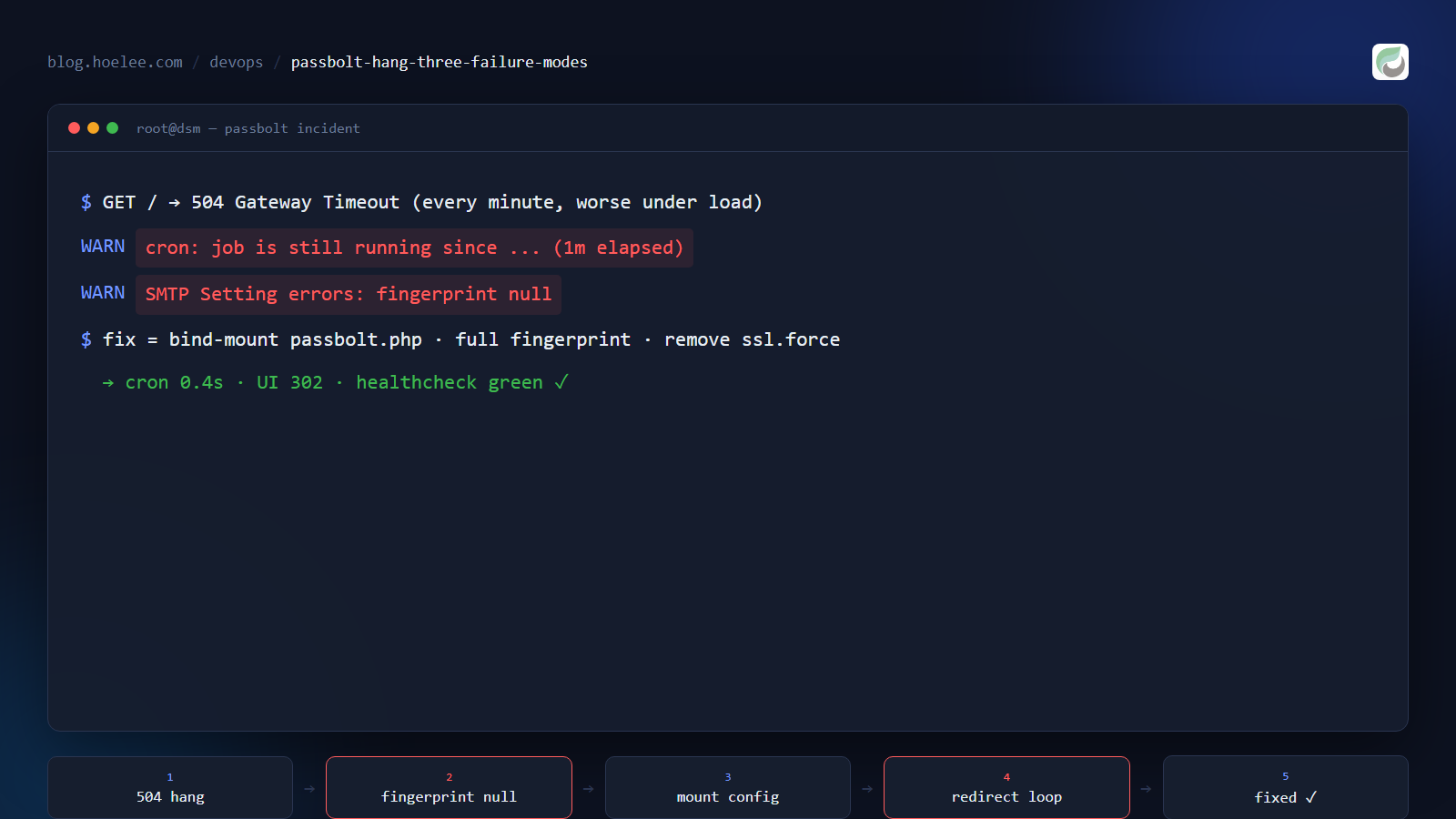
The logs told the story plainly:
not starting: job is still running since ... (1m elapsed)Root cause 1: a null GPG fingerprint
Passbolt stores its SMTP settings encrypted with the server’s GPG key. To use
them, it needs to know which key to decrypt with — a value read from
passbolt.gpg.serverFingerprint. That value comes from a config file,
/etc/passbolt/passbolt.php.
That file didn’t exist.
Without it, the fingerprint resolved to null, GPG decryption of the SMTP
settings failed, and every cron iteration that tried to send mail hung on the
failure. The healthcheck surfaced it as:
SMTP Setting errors: ... setDecryptKeyFromFingerprint():
Argument #1 ($fingerprint) must be of type string, null given
There was also one genuinely dead email in the queue — an old SMTP timeout
record that had exhausted its retries months ago and would never send. It got
re-scanned every minute, adding to the stall.
DELETE FROM email_queue WHERE sent = 0 AND send_tries >= 4;Root cause 2: the fix that didn’t survive (the relapse)
Here’s the part that stung. I had fixed this exact bug once before — by
creating /etc/passbolt/passbolt.php inside the container. Two weeks later
the hang came back, and the file was gone.
The reason: I’d recreated the container during maintenance, and a Docker container’s writable layer is ephemeral by design. Anything written to the filesystem inside the container (rather than into a mounted volume) vanishes on recreate. My fix had the shelf life of the container, not of the deployment.
The durable version is three pieces that all live outside the container:
- A config file on the host, bind-mounted into the image at
/etc/passbolt/passbolt.php:
<?php
return [
    'App' => [
        'fullBaseUrl' => env('APP_FULL_BASE_URL', 'https://pass.example.com'),
    ],
    'passbolt' => [
        'gpg' => [
            'serverFingerprint' => 'A3DD9B762D48722C10CF88DDB5372E46A54E1419',
        ],
    ],
];- The bind mount in compose — the part that makes it survive recreate:
volumes:
- /volume1/docker/passbolt/session-config/passbolt.php:/etc/passbolt/passbolt.php:ro- The correct environment variable name. I’d been using
PASSBOLT_GPG_SERVER_FINGERPRINT, which Passbolt silently ignores. The real variable isPASSBOLT_GPG_SERVER_KEY_FINGERPRINT— and it wants the full 40-character fingerprint, not a truncated one:
PASSBOLT_GPG_SERVER_KEY_FINGERPRINT: "A3DD9B762D48722C10CF88DDB5372E46A54E1419"Root cause 3: the redirect loop I caused myself
With the hang fixed, I upgraded Passbolt from 5.14.3 to 5.15.0. Then, browsing
to https://pass.example.com/, the browser threw:
ERR_TOO_MANY_REDIRECTSI assumed the upgrade had broken something. It hadn’t. The culprit was
ssl.force, which I’d left in my config file:
'passbolt' => [
    'ssl' => [
        'force' => true,
    ],
],
Passbolt’s SSL-force middleware inspects the request’s scheme, and behind a
TLS-terminating reverse proxy that scheme is always http — because the
proxy (nginx) terminates the TLS connection, then forwards plain HTTP to the
container. So the middleware sees http, dutifully redirects to
https://same-url, nginx forwards it back as http, and the cycle repeats
forever.
The fix is to understand who owns SSL. If your reverse proxy already enforces
HTTPS at the edge, the app must not try to force it again. Removing
ssl.force from the config (leaving TLS to nginx) broke the loop immediately.
The general rule, which applies well beyond Passbolt to any app behind a
reverse proxy: either the proxy terminates TLS, or the app does — never
both, and never configure ssl.force in the app while the proxy already
handles it.
What I’d do differently
- Config lives in volumes, not in containers. The moment I wrote a file
into
docker exec, I’d committed to redoing it on the next recreate. The reflex should be: does this need to survive adocker compose up? Then it goes in a bind mount, not the writable layer. - Read the actual variable names. The fingerprint env var cost me a clean diagnosis because I trusted a wrong name that Passbolt ignored without complaint. When a config value “doesn’t work,” check the upstream reference for the exact key before assuming anything else is wrong.
- Test the public URL, not just the healthcheck. The healthcheck passed
every time and missed the redirect loop entirely because it never exercised
the real public path through the proxy. A two-second
curl -Iagainst the live URL would have caught it instantly.
The result
The hang is gone: cron completes in under a second (down from 30–60s), the email queue is clear, and the web UI responds in milliseconds instead of 504-ing. Passbolt is now running the current 5.15.0, with every GPG and SMTP healthcheck green — and the fix is written in a way that survives the next container recreate.
The lesson worth carrying: a self-hosted service that “sometimes hangs” is rarely a mystery. It’s usually one missing config value, surfaced three different ways. Fix the config, not the symptom.
Want stable self-hosted infrastructure for your business?
If you run services like Passbolt, a password manager, email, or a dashboard and they’re flaky — hanging UIs, 504s, mysteries that vanish on restart — I diagnose and fix exactly these problems. I work with Docker, reverse proxies, and self-hosted stacks, and I hand everything back documented so the next person (or future you) isn’t left guessing.
Reach me at [email protected] or WhatsApp +60 12-797 2969, or see what I do at hoelee.com.