Why Telegram Bot Notifications Die: IPv6, DNS, and a 400 That Took a Day
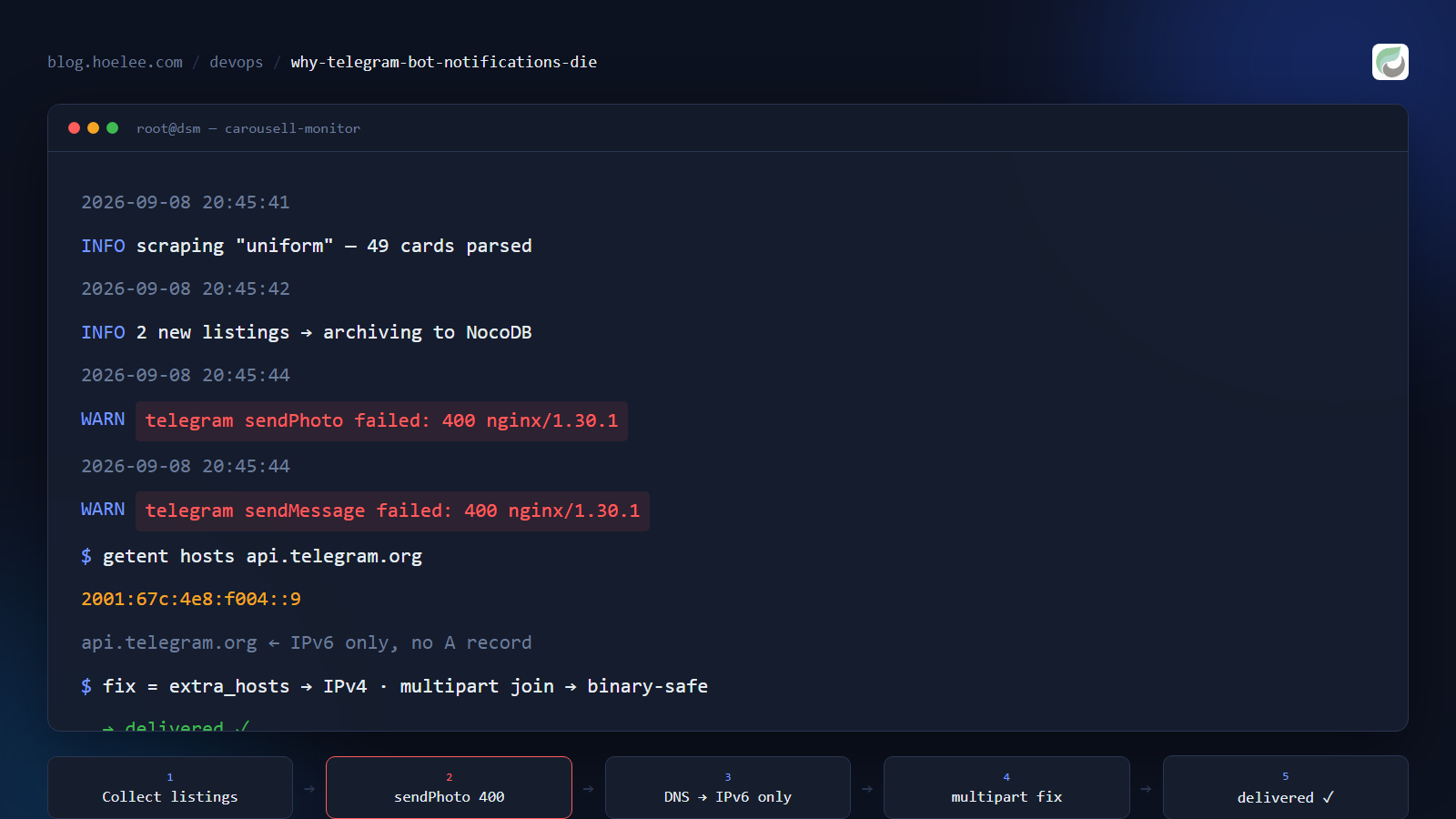
I run a small monitoring bot that watches Carousell for newly-listed listings and pings me on Telegram when something fresh appears. One day it stopped pinging. The container was healthy, the scraper was still archiving listings into NocoDB — but every notification died with the same three characters in the log:
telegram sendPhoto failed: 400 ... nginx/1.30.1That string, nginx/1.30.1, became the villain of a day-long debugging
session. This is the story of how a deceptively small bug turned out to be
three separate problems stacked on top of each other — and how I’d find each
one faster next time.
The problem
The bot had two jobs: collect listings, and notify me. Collection
worked. Notification didn’t. The log said 400 Bad Request and pointed at a
server identifying itself as nginx/1.30.1.
My first assumption was textbook: something in the network is intercepting
the request. nginx/1.30.1 is not a header I associated with Telegram’s
API. A 400 with an HTML body (Telegram returns JSON even on errors) smelled
like a local reverse proxy or a VPN gateway rejecting traffic before it ever
left the machine.
Assumptions like that are cheap. They’re also wrong a lot. Let me walk through what I actually found.
What I tried, and why each thing failed
Round 1: it must be DNS / IPv6
I checked getMe from inside the container. It worked. Then I checked
sendMessage. It failed. Same token, same container, one method up, one down.
The giveaway was in how the two endpoints resolved:
# inside the container
$ getent hosts api.telegram.org
2001:67c:4e8:f004::9   api.telegram.org
The container resolved api.telegram.org to IPv6 only — a single AAAA
record and no A record. The container ran on a Docker bridge network with
no IPv6 connectivity. So every request that needed api.telegram.org was
trying to reach an IPv6 address it had no route to.
The fix looked obvious: pin the IPv4 address with extra_hosts. I did, and
the DNS answer became exactly what I expected:
149.154.167.220 api.telegram.orgAnd the notifications still failed. Same 400. My proud fix did nothing.
Round 2: I picked the wrong IP
Here’s a mistake worth remembering: I hard-coded 149.154.167.220 from
memory. When I finally queried a public resolver, the real A record for
api.telegram.org was different:
149.154.166.110   api.telegram.org   # what DNS actually says
149.154.167.220   api.telegram.org   # what I hard-coded
167.220 is inside Telegram’s IP range (149.154.160.0/20), so it’s not
“wrong” in the sense of being somebody else’s server — but it’s not the
active endpoint, and bot-API traffic to it behaved unpredictably. I switched
to 166.110. It still failed. So the IP wasn’t the whole story either.
Round 3: the same command, two different outcomes
This was the moment the whole thing got weird. Inside one container, at almost the same second:
- the long-running monitor process (
PID 1) →sendPhotofailed, 400 - a fresh
docker execprocess running identical code →sendPhotosucceeded, 200
Same container. Same code. Same payload. Same second.
I ruled out token, chat_id, emoji in the caption, Unicode quotes, image format, environment variables, and the image URL itself — I download-tested the photo and it was a perfectly valid JPEG. Nothing in the code differed between the two paths.
When you hit a contradiction like that — “identical inputs, opposite outputs” — the answer is usually that the inputs aren’t identical. But finding the difference took one more frame change.
Round 4: nginx/1.30.1 is Telegram
I re-read the raw 400 response instead of assuming. The response was an HTML
“400 Bad Request” page, and the Server header was nginx/1.30.1.
That nginx is Telegram’s own edge. Telegram’s API sits behind nginx (version 1.30.1), and when a request is malformed before it reaches their application layer, nginx itself answers with a plain 400 page — no JSON, no friendly error code.
That reframed everything. The request wasn’t being intercepted. It was reaching Telegram, and Telegram’s nginx was rejecting it as malformed.
And the malformed thing was the one part I hadn’t scrutinized: the
sendPhoto multipart body.
The fix
My original code built the multipart body like this — the kind of “obviously fine” line that ships a subtle bug:
body = b"\r\n".join(body_lines)That join looks convenient, but a JPEG is binary data. Its bytes include
\r\n byte sequences in the middle of the image data. Joining with \r\n
as the delimiter corrupts the exact bytes that are supposed to be the image
payload. Telegram receives a body whose multipart boundaries are broken, so
its nginx rejects the request with a 400 before the bot API ever parses it.
The correct approach is to assemble the body field by field, keeping binary data untouched:
boundary = "----tg" + token_hex(8)

parts = []
parts.append(f"--{boundary}\r\n".encode())
parts.append(b'Content-Disposition: form-data; name="chat_id"\r\n\r\n')
parts.append(f"{chat_id}\r\n".encode())

parts.append(f"--{boundary}\r\n".encode())
parts.append(b'Content-Disposition: form-data; name="caption"\r\n\r\n')
parts.append(f"{caption}\r\n".encode())

parts.append(f"--{boundary}\r\n".encode())
parts.append(
    b'Content-Disposition: form-data; name="photo"; '
    b'filename="image.jpg"\r\nContent-Type: image/jpeg\r\n\r\n'
)
parts.append(image_bytes)          # ← binary stays binary
parts.append(b"\r\n")

parts.append(f"--{boundary}--\r\n".encode())

body = b"".join(parts)             # join bytes, not lines
The difference is b"".join(parts) instead of b"\r\n".join(...): each part
is already a complete chunk with its own framing, and we concatenate them
verbatim rather than inserting a delimiter between every element.
There’s a second, higher-level fix worth naming: stop asking Telegram to download the image for you. My earlier code passed the image as a URL and let Telegram fetch it:
tg("sendPhoto", {"photo": image_url, "caption": caption})That means Telegram’s servers have to reach out to the source CDN — and if that CDN is flaky or geo-blocks Telegram’s crawlers, you get intermittent failures that are impossible to reproduce locally. Downloading the image yourself, then uploading the bytes, removes an entire class of flakiness and gives you a chance to validate the bytes before you send them.
What I’d do differently
- Read the raw response, not the assumption.
nginx/1.30.1sat in logs for hours while I chased phantom proxies. Look up who owns the header before inventing a man-in-the-middle. - Verify a hard-coded IP against a live resolver. Memory is not DNS.
dig +short api.telegram.orgtakes three seconds and would have saved me a whole round. - Treat “identical inputs, opposite outputs” as a lie. The inputs were never identical — the two processes differed somewhere I wasn’t looking. The honest move is to diff the bytes, not the code.
- Never hand-join binary data with a text delimiter.
b"\r\n".join()on a mix of text and JPEG is a corruption bug waiting to happen.
The result
After the multipart fix, the monitor pushed a real notification through on the next tick — image and all. I also folded in a retry queue so a failed notification stays marked un-sent and is retried 30 seconds later instead of silently vanishing. The whole episode cost the better part of a day, but it turned into exactly the kind of bug I’ll never trip over twice.
The bot is a personal project, but the lesson generalizes to any service that relies on outbound notifications. If you’ve got a monitor, a scraper, or an alert pipeline that needs to reach people reliably, let’s talk.
I build reliable notification and monitoring pipelines — Telegram/WhatsApp alerts, scrapers, and the infrastructure around them. Tell me what you need to watch and where you need it delivered: