Why Unraid Hangs When You Stop the Array With a Swapfile — and the Fix
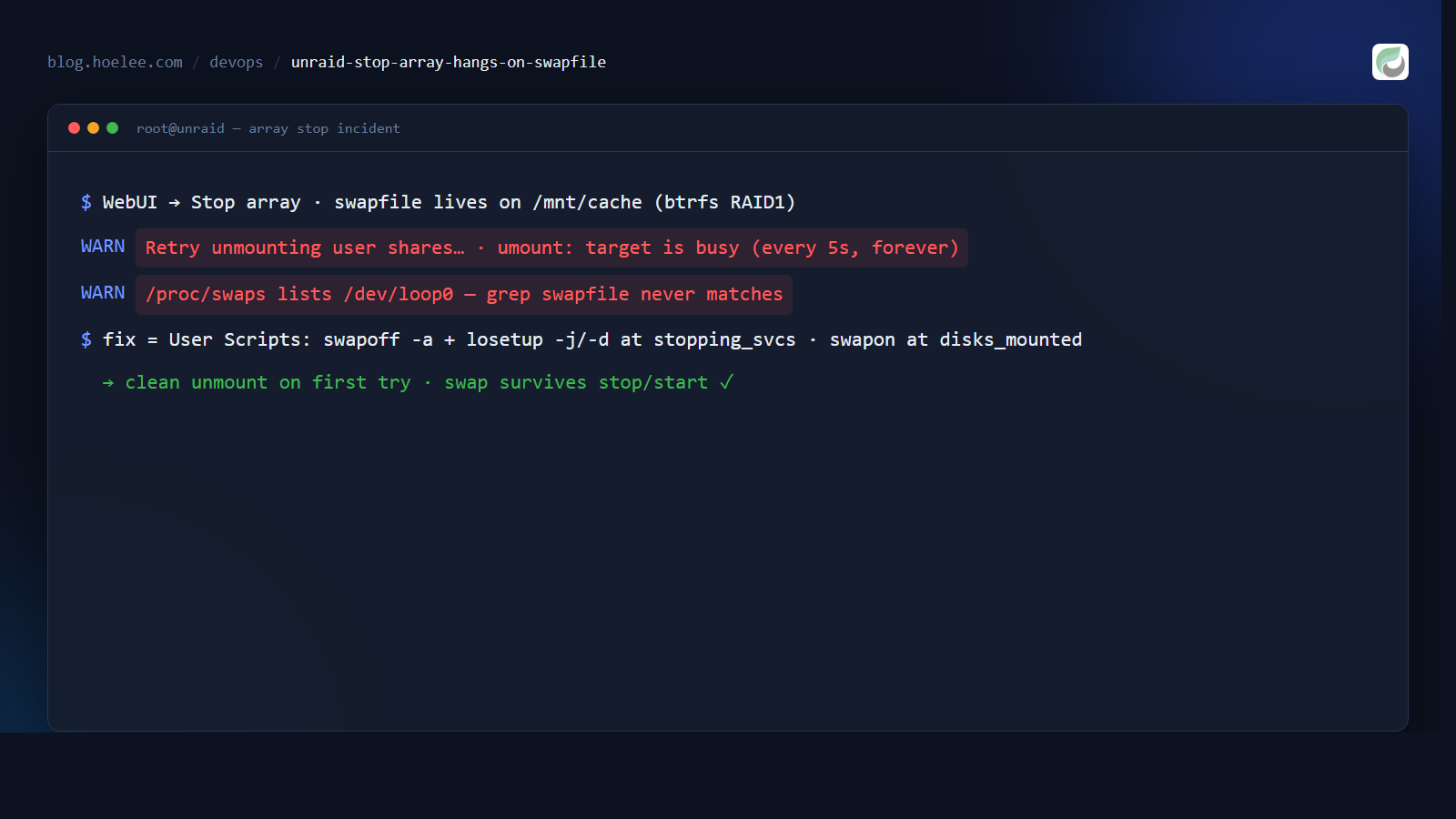
I added an 8 GB swapfile to my Unraid server — my cache pool is a btrfs RAID1, and the kernel refuses a swapfile that lives directly on a multi-device btrfs filesystem, so it goes through a loop device, the standard workaround. Swap worked. Memory pressure dropped. Everything was fine… until the day I stopped the array.
The WebUI sat on “Retry unmounting user shares…” forever. The cache pool
would not release. Docker was stopped, VMs were shut down, shares were
unmounted — and still, umount /mnt/cache failed with target is busy,
every five seconds, indefinitely. The only way out was a reboot.
This is the story of finding out why, the trap I fell into on the way
(/boot/config/stop does not run when you click Stop), and the two-script
fix that survives every stop/start cycle since.
The problem, phrased the way you’d Google it
If you landed here from a search, you’re probably typing one of these:
- “unraid stop array stuck retry unmounting user shares”
- “umount /mnt/cache target is busy unraid”
- “unraid swapfile stop array hang”
- “unraid won’t stop array after adding swap”
Same bug. The short version: a swapfile — or its loop device — is held open
by the kernel’s swap subsystem, and Unraid’s array-stop sequence has no step
that turns swap off before it unmounts disks. The mount is busy because the
kernel itself is using it, and it will keep using it until someone runs
swapoff. Nobody does.
What I tried, and why it failed
Attempt 1: reboot, stop array again — hung again
Obviously. The swapfile was still configured in /boot/config/go, so every
boot recreated the loop device and enabled swap on it. Every stop hit the same
wall. At least this confirmed it was deterministic, not a one-off stuck
process.
Attempt 2: put a swapoff in /boot/config/stop
This is the classic trap, and the Unraid docs make it look like the right
answer. The stop script exists precisely for “run cleanup before disks go
away” — and it does run, but only during a full shutdown or reboot.
I checked on my own box (Unraid 7.1.4): /boot/config/stop is invoked by
rc.local_shutdown, which is called from rc.6. Clicking Stop in the
WebUI goes through a completely different path — emhttpd fires a series of
events — and rc.6 is never involved. No shutdown, no stop script, no
swapoff. The array stop still hung.
Attempt 3: read what the GUI Stop actually does
This is where the real answer lives. Unraid’s event dispatcher (emhttp_event)
runs hook scripts in a documented sequence when the array stops:
stopping → stopping_libvirt → stopping_docker → stopping_svcs
        → unmounting_disks → stopping_array → stopped
Two facts matter:
- The unmount happens at
unmounting_disks. Any swapoff must fire atstopping_svcsor earlier — one event before the unmount. - These events are exactly what the User Scripts plugin exposes as
schedule options (“At Stopping of Array” =
stopping_svcs, “At Startup of the array” / “At First Array Start only” =array_started/disks_mounted). No new code needed — the automation surface already exists.
The subtle part: /proc/swaps lies about loop-backed swap
Here’s the gotcha that makes even a “correct-looking” cleanup script fail.
My /boot/config/go set swap up like this (the standard btrfs-RAID1 recipe):
# /boot/config/go — the original (broken-on-stop) setup
mkdir -p /mnt/cache
MOUNTPOINT=/mnt/cache
SWAPFILE=${MOUNTPOINT}/swapfile

# Wait for the cache pool to be mounted
while [ ! -f "${SWAPFILE}" ]; do
  sleep 1
done

# Btrfs RAID1 rejects direct swapfiles: loop device + NOCOW
chattr +C "${SWAPFILE}"
LOOPDEV=$(losetup -f)
losetup -p 100 "${LOOPDEV}" "${SWAPFILE}"
swapon -p 1 "${LOOPDEV}"
Now look at what the kernel reports while that’s active:
$ cat /proc/swaps
Filename                Type        Size      Used    Priority
/dev/loop0              partition   8388604   0       -2

$ swapon --show
NAME       TYPE SIZE USED PRIO
/dev/loop0 partition  8G   0B   -2
The filename is /dev/loop0, not /mnt/cache/swapfile. So a cleanup
script like this one:
# WRONG — silently does nothing for loop-backed swap
grep -q '/mnt/cache/swapfile' /proc/swaps && swapoff /mnt/cache/swapfile
…matches nothing, swaps nothing off, and you’re back to the hang. You have to
resolve the loop device first — losetup -j <file> does exactly that — then
swapoff the loop device, then detach it. The ZRAM Compressed Memory plugin
documents this same bug in its source comment, almost word for word: “for
loop-backed swap, /proc/swaps lists /dev/loopN, not the image path — a plain
grep never matches, so swapoff never ran and the loop device kept the pool
busy forever.”
The fix: two User Scripts
User Scripts is already installed on most Unraid boxes. Create two scripts:
Script 1 — “Array Stop Swapoff” — schedule: At Stopping of Array
(fires at stopping_svcs, one event before the unmount):
#!/bin/bash
# Release ALL swap, then detach only the loop device backing OUR swapfile.
swapoff -a 2>/dev/null
for l in $(losetup -j /mnt/cache/swapfile 2>/dev/null | awk -F: '{print $1}'); do
  losetup -d "$l" 2>/dev/null
done
losetup -j (“which loop device is attached to this file?”) is the key move —
it’s immune to the /proc/swaps naming lie. And detaching only our loop
device matters: a box can have other loop devices (mounted ISOs, other images)
that must survive an array stop.
Script 2 — “Array Start Swapon” — schedule: At First Array Start only
(fires at disks_mounted):
#!/bin/bash
# Re-create the loop-backed swap after the cache pool mounts.
[ -f /mnt/cache/swapfile ] || exit 0
LOOP=$(losetup -f)
losetup -p 100 "$LOOP" /mnt/cache/swapfile && swapon -p 1 "$LOOP"
Why “First Array Start only” and not plain “At Startup of the Array”? Because
/boot/config/go also runs at boot and would set swap up a second time. The
first array start after boot is covered by go; this script matters for the
GUI stop → start cycle with no reboot in between — which go never sees.
(In my setup I moved the swap block out of go entirely so the User Script is
the single source of truth — one place, both paths.)
After this: Stop → cache unmounts cleanly on the first try. Start → swap is back. Verified across multiple stop/start cycles and reboots.
What I’d do differently
1. Don’t put swap on a disk that’s already dying. My cache pool is a pair of NVMe drives I’ve since confirmed are silently corrupting data (reads returning all-zero blocks despite clean SMART). An 8 GB swapfile there meant constant write wear on hardware I was about to replace — and it was the very thing pinching my array stops during the migration. Match swap location to disk health, not convenience.
2. Prefer compressed RAM over disk swap when you have the CPU for it. The endgame on this box was the ZRAM Compressed Memory plugin: Tier-1 swap lives in a zstd-compressed RAM-backed block device. Two wins:
- The hang becomes structurally impossible. A zram device is not a mount.
umount /mnt/cachecan never see it, so there’s nothing to release at stop time. (The plugin also ships a properevent/stoppinghook with thelosetup -jfix, if you enable its Tier-2 disk swapfile.) - Swap-in/out is microseconds of CPU work instead of disk I/O — on a modern many-core CPU, compression is nearly free relative to even NVMe latency, and you save ~3:1 on the RAM the swapped pages occupy.
One caveat I learned the hard way: the plugin’s auto-size (50% of RAM) gave me a 31.3 GB zram device on a 62 GB host that was already 90% full. That number is an uncompressed ceiling — real RAM cost is capacity ÷ compression ratio, so a full 31.3 GB zram could eat 10–30 GB of the very RAM I was short of. On a nearly-full host, size zram fixed and modest (I went to 8 GB, the old swapfile size, swappiness 150) so it buffers OOM instead of competing with it.
3. Swap delays OOM; it doesn’t cure it. The honest root cause of my memory pressure was VM RAM budgets, not a missing swapfile. Swap bought headroom and kept the host alive during spikes — but the real fix was right-sizing guests.
The result
Array stop went from “hangs forever, forced reboot” to clean unmount on the
first attempt, and swap now survives stop/start cycles without manual
intervention. Total fix: two shell scripts in a plugin that was already
installed. The expensive part was knowing where in the event sequence to
put them — and that /proc/swaps won’t tell you the truth about loop-backed
swap.
If your Unraid array refuses to stop and you have any swap configured — file,
loop, or otherwise — swapoff -a from a root shell will release it
immediately, and you’ve confirmed the diagnosis. Then automate it before the
next reboot wipes your memory of how.
Run a self-hosted stack that needs this kind of debugging — Unraid, Docker, reverse proxies, NAS migrations? I do this for a living: website design & development is my main work, and self-hosted infrastructure is where I go deep. Reach me on WhatsApp or email.