How I Vet an Open-Source Dependency Before Betting On It
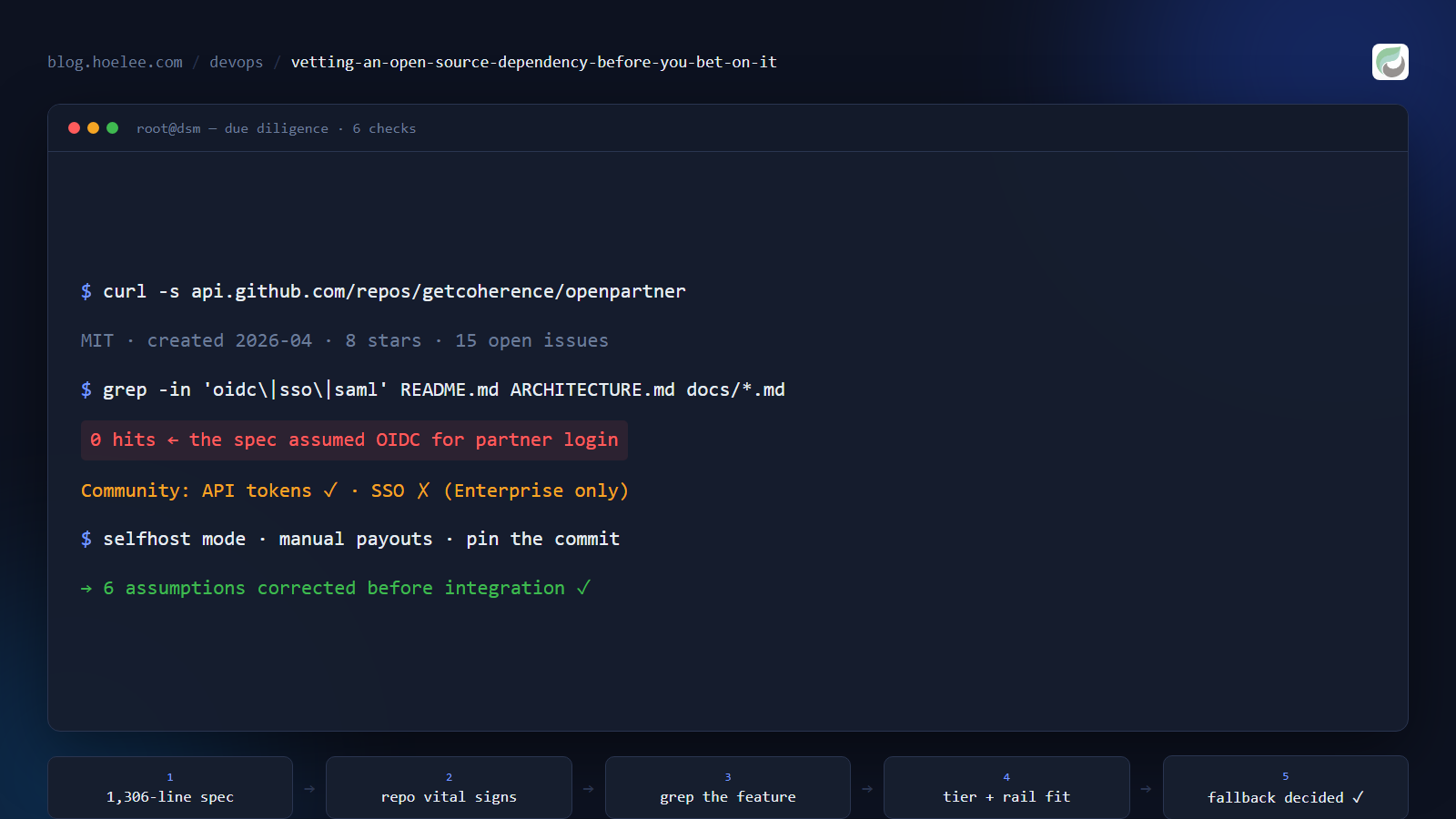
I was handed a 1,300-line architecture spec for a partner program. It read like a plan: consistent, cross-referenced, confident. It named a self-hosted open-source engine as the attribution and commission layer, and it assumed three things about that engine — that it spoke OIDC so my existing identity provider could log partners in, that its commission rules covered the five shapes the business needed, and that its white-label feature was shipped.
Ten minutes of curl and grep later, two of those were false and the third was
half-true. None of that is unusual. The README describes the product; the
repository describes the software. The gap between those two is exactly where
integration projects die — and it is cheap to measure before you write any code.
The problem, phrased as the question I’d actually search for
How do I know an open-source project does what its documentation claims before I build on it?
A spec is a claim about other software. The more polished the spec, the more its assumptions read like facts — this one cited sources, defined stable IDs, and had a source-of-truth matrix. What it never did was check whether the engine down the chain implemented the features being assigned to it. So before installing anything, I went looking for those specific features.
What I tried first, and why it wasn’t enough
1. Read the README end to end. It sells the pipeline well:
click → identity → event → attribution → commission → payout. It never once
says which authentication protocol the app speaks. For a feature you need,
silence isn’t neutral — but an absent mention is easy to skim past when the rest
of the page is convincing.
2. Searched the web. Several of my queries returned nothing usable. The project is a few months old and its SEO surface is thin. For software that’s fine — the source is the documentation. It just means the reading has to happen in the repo, not in a blog post.
3. Found a 78 KB feature design doc and assumed the feature shipped. It was labelled “FINAL, post-review”, listed three reviewers, and carried a date. I took that as proof. That was the worst inference of the three, and the easiest to check.
The six checks that actually settled it
1. Read the repo’s vital signs before any feature claim
curl -s -H "User-Agent: hermes" https://api.github.com/repos/<owner>/<repo> \
  | grep -E '"created_at"|"pushed_at"|"stargazers_count"|"forks_count"|"open_issues_count"|"archived"|"spdx_id"'
What came back: MIT, created 2026-04-23, last push 2026-09-10, 8 stars, 3 forks, 15 open issues, not archived. Read the same as: real, still moving, and very small — one vendor, which also sells a hosted tier. Now I know how much of my business I want resting on it before I start grading its features.
2. Grep for the feature instead of reading for it
grep -in 'oidc\|sso\|saml' README.md ARCHITECTURE.md docs/*.md | wc -lZero hits. The app authenticates with its own magic-link sessions and per-persona API keys; it does not speak OIDC at all. That one line of output killed a phase of the plan — “put the portal behind our SSO provider” — which would otherwise have surfaced weeks later, mid-integration, with a partner already invited. Reading for a feature you can’t find is how you lose an afternoon; grepping makes the absence loud.
3. Read the target branch line at the top of a feature doc
head -5 docs/white-label-custom-domains.mdTarget branch: multi-tenant. The doc is a design for a branch that is not the
default branch — it describes work in flight, so the feature is not in the code
you would install. A finished-looking document with reviewers and dates can
document something unshipped. That isn’t dishonesty; it’s what design docs are.
4. Read the data model, not the feature list
The commission section named exactly two rule types — percent (with a recurring
flag) and fixed. The business spec had enumerated five. That gap isn’t a bug;
it’s a modelling job I’d have to do in configuration instead of expecting from
the product:
| Spec assumed | What the engine actually has |
|---|---|
| first-order bonus | a fixed rule on the first event |
event-specific rules (lead vs invoice_paid) | one rule per campaign — so: two campaigns |
| recurring commission | percent + recurring: true |
| percentage | percent ✅ |
| fixed | fixed ✅ |
Two rule primitives, five behaviours — workable, but only if you design for it up front instead of discovering it during implementation.
5. Check which paid tier gates the feature you need
For the database tool in the same stack, the edition table was blunt:
| Feature I needed | Community (free) | Enterprise (paid) |
|---|---|---|
| API tokens, so I can automate it | ✅ | ✅ |
| SSO / OIDC | ❌ | ✅ |
| Page designer, hide branding, 2FA | ❌ | ✅ |
The thing I wanted for the partner-facing door (SSO) sits behind the commercial gate, while the thing I wanted for automation (an API token) is free. Knowing which side of the wall each requirement falls on changes the design — before you’ve designed around it.
6. Check that the money rail works in your country
The payout model was stripe_connect | manual, and self-hosted mode was
documented as “operator manages out-of-band” — i.e. you move the money yourself.
Stripe Connect is not how Malaysian businesses pay partners, so that one line
decided the entire deployment shape: self-host mode, manual payouts, and event
ingestion pushed from my own order system rather than leaning on the provider’s
payment integration. That line is never on a marketing page, and it mattered more
than any feature.
Then: ask the fallback question before you need it
“What if the feature I need isn’t there?” For the missing SSO the answer was:
don’t put login in the app, put it in front of the app. authentik’s proxy
provider exists to protect “applications that do not support native
authentication protocols such as OIDC, SAML, or LDAP”, and it injects
X-authentik-username and X-authentik-groups headers upstream, so the reverse
proxy can do the gating. That turned “no SSO support” from a disqualification
into an afternoon of config.
What I’d do differently
- Write the requirement list first, then go look for it. Five lines — the features I need — and search for those. Starting from the README’s feature list means grading the software on the vendor’s exam.
- Treat “a doc exists” as different from “a feature ships”. Read the branch line.
- Grep, don’t read. Presence is cheap to prove; absence is the thing you’re hunting.
- Decide the fallback before the decision, so a missing feature becomes a design change rather than a surprise.
- Pin the commit. This project’s README says its API is “stable but unversioned” and there is no OpenAPI description anywhere in the tree. There’s no contract to compile against, so the commit hash is the contract — the endpoints I use go into my own docs, and upgrades get a regression pass.
The result
Six assumptions corrected in about ten minutes of curl and grep, before a
single line of integration code existed. The project stayed viable — but
reshaped: no OIDC, manual payouts, a pinned commit, and a plan that no longer
depends on a feature sitting on an unmerged branch.
The spec wasn’t wrong to be optimistic. It was wrong to be unverified, and that’s the cheapest thing on the whole project to fix.
Building on a self-hosted stack, and want a second pair of eyes on whether those features will actually be there when you integrate? That’s the kind of review I do.