Best AI Video Generators in 2026: Free vs Paid, and My LTX-2.3 Test
Which AI video generator should you actually use in 2026 — and how much of it can you really get for free?
AI video has changed faster than almost any other creative tool I’ve used. A year ago, decent video generation meant a paid subscription and hoping for the best. Today you can generate synchronized video and audio with an open-weight model on your own GPU, or get genuinely useful free credits from half a dozen platforms.
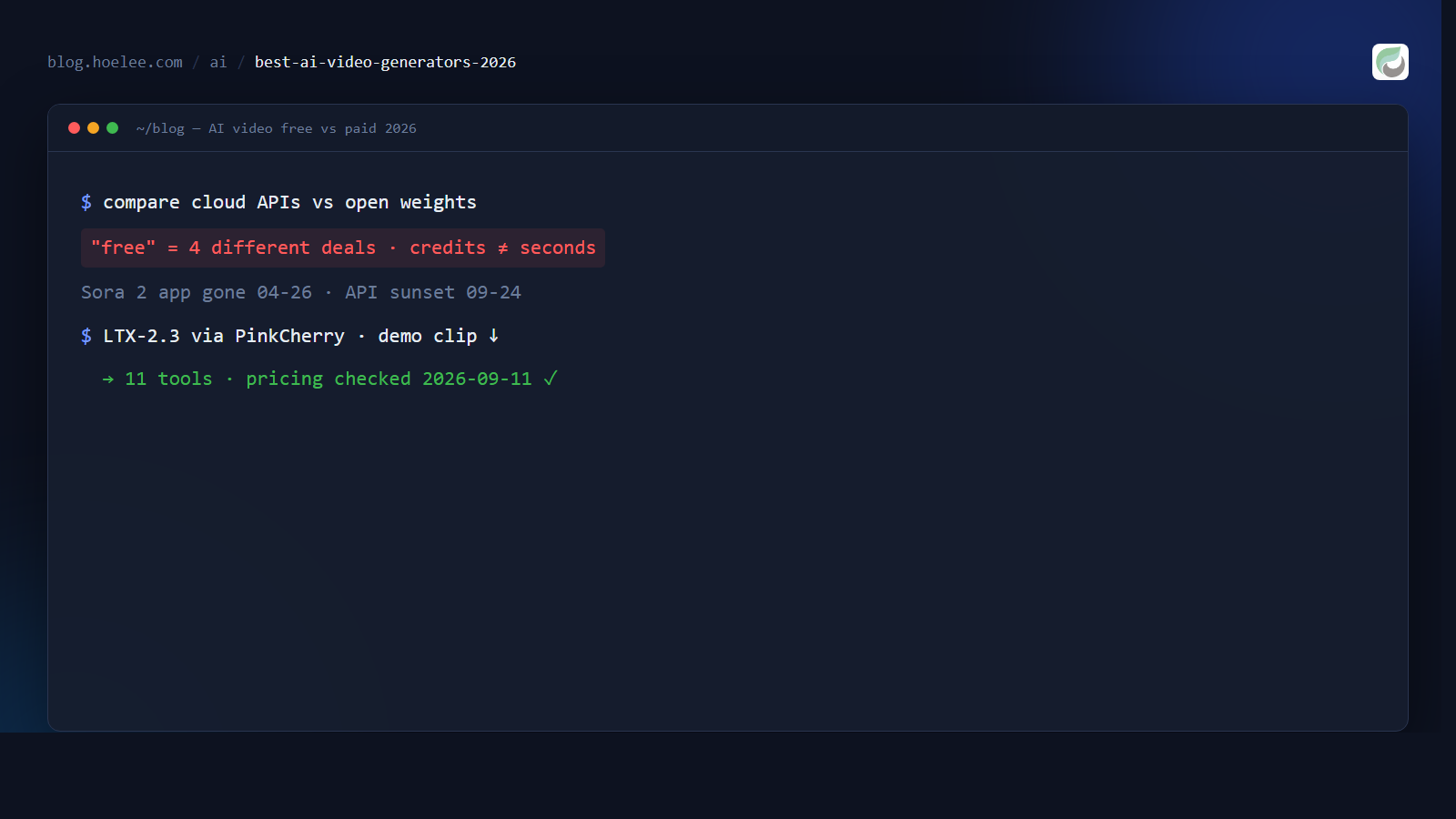
But there’s a catch hiding in the word “free”. It means at least four different things in this market, and most articles don’t tell you which one they’re talking about. This guide compares the options that are actually usable in 2026, separates marketing from reality, and ends with a hands-on test: I generated a short video with the open-weight model LTX-2.3 through PinkCherry, and I’ll show you the result.
Pricing and free quotas below were checked on September 11, 2026. This market moves monthly — always verify against the provider’s current pricing page before you commit.
What “free” actually means in 2026
Before comparing tools, you need to decode the word. There are four different deals hiding behind “free AI video generator”:
- Free daily or monthly credits — you get a set number of credits that refresh. Pika (80/month), PixVerse (daily), and Kling (66/day) work this way.
- A one-time free trial — you get an allocation once, and it never comes back. Runway’s 125 credits are the classic example.
- Open weights — the model itself is free to download and run. But “free model” doesn’t mean free compute: you still need a GPU, electricity, and setup time.
- A hosted demo or community platform — someone else runs the model for you (like PinkCherry, where I tested LTX-2.3). Quotas, queues, and availability can change without notice.
Same word, wildly different economics. A platform advertising “free AI video” is usually meaning #1 or #2. A model card advertising “free” is meaning #3 — and it quietly shifts the cost to your hardware.
Why “model” and “platform” aren’t the same thing
Another distinction that trips people up: Seedance 2.5, Kling, and Veo are models. PixVerse, fal.ai, and Runway are platforms — and platforms often resell each other’s models.
Concrete example: Seedance 2.5 is ByteDance’s model. You can use it through ByteDance’s own products, through PixVerse (where it generates up to 30-second clips), or through fal.ai’s API. Each route has different pricing, and none of those prices is “the” Seedance price. Kling is even messier — its own subscription copy references “Video 2.6” while third parties resell a “Kling 3.0” endpoint, so trust the model picker, not the blog posts.
This matters because comparing “Seedance vs PixVerse” is comparing a model against a platform. Compare like with like: model-to-model, platform-to-platform, and API-to-API.
Quick comparison
| Tool | Free option | Paid option | Max clip | Native audio | Open/local | Best for |
|---|---|---|---|---|---|---|
| Pika | 80 credits/mo, 480p, watermarked | from ~$8/mo | ~5–10s | SFX | No | fast social clips |
| PixVerse | 90 signup + 60 daily credits | from ~$10/mo | up to 30s (Seedance 2.5) | model-dependent | No | many models in one place |
| Kling | 66 credits/day, 5s, 720p, non-commercial | from ~$7–10/mo | 10s | yes (paid) | No | value + motion physics |
| Seedance 2.5 (via fal.ai API) | none | ~$0.22–1.16/s | up to 30s | yes | No | cinematic short clips |
| Veo 3.1 (Gemini API) | none on API (limited free in Gemini app) | $0.05–0.40/s | 8s (+ extend) | yes | No | top quality |
| Runway | 125 one-time credits | from ~$12–15/mo | 10s + extend | via bundled models | No | creative editing workflow |
| Hailuo (MiniMax) | generous daily credits, watermarked | from ~$10–15/mo | 6s | no | No | free previz |
| Luma (Ray3) | ~30 gen/mo, watermarked | from ~$25–30/mo | ~10s | no | No | cinematic look |
| LTX-2.3 / LTX-2.5 | open weights, free under $10M ARR | LTX API from ~$0.09/s | ~10s | yes | Yes | local / self-hosted |
| Wan 2.2 | open weights (Apache 2.0) | — | ~5–10s | no | Yes | local, no audio needed |
| Sora 2 | — shutting down Sept 24, 2026 | $0.10–0.70/s until sunset | up to 20s | yes | No | avoid — being retired |
More detail on each below. Remember: credits are not seconds. “2,000 credits” sounds huge until you learn one 10-second 1080p clip costs 70–100 of them.
1. Pika — the cheapest real starting point
Pika’s free Basic plan gives you 80 monthly credits — roughly five or six 5-second 480p clips a month. It’s watermarked, capped at 480p, and has no commercial use and no watermark-free download (those start on paid plans). Several older articles claim Pika’s free tier is watermark-free; as of September 2026 that is not true.
Paid plans start around $8/month. For the money you get faster generation, higher resolution, Pikaffects (explosion, melt, morph effects built for virality), and keyframe control.
Best for: people who want the lowest-friction way to make fun short-form clips for social media. Not for serious cinematic work — raw quality trails Veo, Kling, and Seedance.
2. PixVerse — many models, one credit balance
PixVerse is the clearest example of the model-vs-platform distinction. One account, one credit pool, and a model selector that includes Seedance 2.5, Seedance 2.0, Kling, Veo 3.1, and its own V6 — which makes it the easiest place to compare models side-by-side without five subscriptions.
Free tier: 90 signup credits plus 60 daily credits — roughly a video or two a day depending on model and resolution. Paid plans start around $10/month and unlock higher resolutions and the bigger models (Seedance 2.5 itself is currently gated to paid members).
Pricing is per-second and varies wildly by model and resolution — Seedance 2.5 costs far more per second than the in-house V6. That’s why comparing tools by “price per video” without naming the model and resolution is meaningless.
Best for: people who want to try many models in one place and compare output quality directly.
3. Kling — best value for motion, with a confusing tier ladder
Kling (Kuaishou) is the value leader in 2026. Its Kling 3.0 model (released February 2026) tops the Artificial Analysis image-to-video leaderboard, with notably believable physics — cloth, water, hair.
The free tier gives 66 credits per day (they reset every 24 hours, they don’t accumulate, and the exact amount can vary by region and account age). The catch is on three levels: output is watermarked, non-commercial, and — the part most reviews bury — free users get the older Kling 2.1 at 5 seconds and 720p. Kling 3.0 starts on paid plans.
Paid plans list from about $10/month (intro promos around $7, renewal higher) for 660 credits. Watch two gotchas: subscription credits don’t roll over, and failed generations still deduct credits.
Best for: creators who want the strongest motion quality per dollar and don’t need the free tier for anything commercial.
4. Seedance 2.5 — powerful, but read the pricing carefully
Seedance 2.5 is ByteDance’s current flagship. It does text-to-video, image-to-video, and reference-to-video (multiple reference images for visual consistency), with native audio and generation up to 30 seconds — unusually long for a single clip.
There is no universal Seedance price, because the model isn’t sold directly at one price. On fal.ai, an independent API provider, approximate standard pricing is:
- 480p: ~$0.22/second
- 720p: ~$0.47/second
- 1080p: ~$1.16/second (rolled out August 2026)
A 10-second 720p clip on fal runs about $4.70. WaveSpeed lists 1080p around $0.90/second. On PixVerse, Seedance 2.5 is available to paid members at per-second credit rates. These are third-party prices — ByteDance’s own consumer products price differently — but they’re the realistic numbers if you’re building on an API.
Best for: filmmakers and developers who want cinematic, consistent short clips and are comparing API economics, not consumer subscriptions.
5. Google Veo 3.1 — the quality crown, with three speed tiers
Most independent testing in 2026 puts Veo 3.1 at the top for realism and prompt accuracy, and it generates synchronized audio in the same pass. Google’s official API documentation lists 8-second clips at 720p, 1080p, or 4K, with extension, first/last-frame control, and up to three reference images.
The API has no free tier — everything is pay-per-second:
- Veo 3.1 Lite: $0.05/s (720p) — cheap iteration
- Veo 3.1 Fast: $0.10/s (720p), $0.12/s (1080p), $0.30/s (4K)
- Veo 3.1 Standard: $0.40/s (720p and 1080p), $0.60/s (4K)
Consumers can try Veo free inside the Gemini app on limited daily usage — the API itself is paid-only. Note that Veo 3 was deprecated on June 30, 2026; 3.1 is the current line, and Google has also previewed Gemini Omni Flash, a video generation and editing model around $0.10/s.
Best for: anyone who wants the best output and is fine paying per clip — and developers who want predictable per-second API costs.
6. Runway — a creative workflow, not just a generator
Runway has become a video workspace: its Gen-4.5 model plus a real editing timeline, motion brushes, inpainting, and character consistency — and it now resells Veo 3.1, Kling, and Seedance inside the same editor. One subscription, many models. That aggregation is the real reason to pay.
The free tier is the clearest example of “one-time trial”: 125 credits, once, ever. They don’t renew, the free tier is image-to-video only with a watermark, and it can’t touch Gen-4.5 or Veo.
Paid: Standard ~$12–15/month for 625 credits, Pro ~$28–35/month for 2,250, Max ~$76–95/month. Do the credit math before buying: Gen-4.5 burns roughly 12–25 credits per second, so the Standard plan’s 625 credits is only about 25–50 seconds of flagship video a month.
Best for: creators who need to stitch clips into longer cuts, hold a consistent character, and edit — not just prompt.
7. Hailuo and Luma — the “worth knowing” pair
Hailuo (MiniMax) has the most genuinely usable free tier for evaluation: generous daily credits, watermarked, 6-second clips. Quality for realistic human motion punches well above its price. Paid from ~$10–15/month; API around $0.07–0.08/second makes it one of the cheapest serious options for developers.
Luma (Ray3) is the rare tool with a real HDR and color pipeline (16-bit HDR, EXR export) aimed at actual film workflows. Free tier gives roughly 30 watermarked generations a month; paid plans sit around $25–30/month — pricier than Pika or Kling, and the free allowance is small. It’s the pick if you want a cinematic look and work in film-oriented formats.
What happened to Sora 2 — and why you should care
If you’ve read older guides, you’ll notice Sora 2 is missing from the recommendations. OpenAI discontinued the Sora app on April 26, 2026, and the Sora API is scheduled to shut down on September 24, 2026. As of this writing, you cannot buy a Sora subscription, and building on the API means migrating in days.
It’s a useful lesson in how fast this market turns: a model that was “best overall” in early 2026 is gone before the year ends. When you choose a platform or model for real work, check when it was last updated and whether the company is still shipping — the best model in the world is useless if the API sunset is next month.
LTX-2.3 and LTX-2.5 — the interesting open/local route
This is the part that changes the economics. LTX is the open-weights video line from Lightricks (now spun out as LTX). It’s an audio-video foundation model: video and synchronized audio generated in a single pass — dialogue, lip-sync, ambience — which was a hosted-only capability until recently.
- LTX-2.3 (March 2026) — the version I tested. Open weights, synchronized audio, portrait and landscape.
- LTX-2.5 (August 11, 2026) — the current release. 22B parameters, native multishot generation (several connected scenes in one output, holding character, lighting, and voice across cuts), 4K HDR, a new diffusion video decoder with fewer artifacts, and a Gemma 4 text encoder. Day-one ComfyUI support.
Licensing matters here: it’s the LTX Community License, free for commercial use if your company earns under $10M ARR — no mandatory branding, no per-seat fees. Above that, you negotiate a paid license.
You can run it three ways: self-hosted on your own GPU (roughly 16–24GB VRAM reported for reasonable speeds — check the current requirements), through ComfyUI workflows, or via the LTX API (from about $0.09/second at 720p).
Why this is a big deal: an open-weights model with synchronized audio changes the cost question from “what’s the subscription?” to “what’s my GPU budget?”. The trade-off is real — setup time, hardware cost, and results that depend heavily on your workflow, quantization, and settings. But for experimentation, learning, and full control, nothing else in this list compares.
My LTX-2.3 test
I generated this short clip with LTX-2.3 in my own ComfyUI setup — a local install I’ve nicknamed PinkCherry. It’s a real-world test, not a benchmark — no claims about speed or quality leadership here, just what the model did when I pointed it at a prompt and let it work.
My LTX-2.3 demo clip, generated locally in ComfyUI with the PinkCherry workflow (hosted on content.hoelee.com).
What made this experiment interesting wasn’t that LTX beats the commercial models — on raw polish it doesn’t need to, and I’m not going to claim otherwise. It’s that this is an open-weight, local-oriented model:
- Different cost structure. No subscription, no per-clip API bill. The cost moves to GPU hardware, electricity, and setup time — which is a capital cost you can amortize, not a recurring one.
- More control. You can run it in ComfyUI, swap checkpoints, quantize to fit your VRAM, and fine-tune under the community license.
- It’s the model’s job to evolve fast. I tested 2.3; 2.5 shipped a month later with multishot and 4K HDR. Open weights mean you don’t wait for a company to upgrade you.
The honest caveats: your results depend heavily on hardware, workflow, model version, and quantization. A hosted playground (like a Hugging Face Space or ComfyUI.cloud) is meaning #4 of “free” — great for a first taste, but queues and quotas can change, and serious local use means learning ComfyUI.
If you want to try it yourself: grab the weights from Hugging Face and a community ComfyUI pack, or use a hosted playground for a first test, then decide if local setup is worth it. For me, it was — which is exactly why this article exists.
How I made it: the LTX-2.3 ComfyUI workflow
Here’s how the test above was actually made — the workflow behind the clip. Nothing exotic: just the standard LTX-2.3 parts, all free nodes:
- Image-to-video pipeline with a second pass. A reference image becomes a video latent, gets sampled, then runs through a 2× spatial latent upscaler for the final pass.
- Separate video and audio VAEs. LTX-2.3 generates synchronized audio in the same pass, and it needs its own audio VAE alongside the video VAE — that’s the piece that makes the sound part of the generation instead of an afterthought.
- Gemma 3 12B text encoder. The LTX line uses Gemma as its language backbone, loaded with the LTX text projection.
- Distilled checkpoint + LoRA. The fast distilled variant with the distilled LoRA at 0.6 strength, at 24 fps and 5–7 second clips — the practical sweet spot for LTX.
- GGUF quantization + Chunk FeedForward. The model loaded GGUF-quantized, with chunked feed-forward layers — that’s how a 22B model fits on consumer VRAM.
- Negative audio guidance (NAG). Separate negative prompts for the video track and the audio track (e.g. “voice over, narration, off-camera speech” for audio), which keeps the generated sound clean.
- A tiny preview VAE for fast in-sampler previews instead of full decodes.
The prompt matters more than any single node. LTX rewards prompts that describe action over time and weave the audio layer in from the start — its own guidance (reproduced from the workflow’s notes):
- Core actions: describe events and actions as they occur over time.
- Audio: describe sounds and dialogue needed for the scene.
- Reference image: don’t repeat details already present.
- Consistency: avoid instructions that don’t match the reference image — they degrade results.
The exact prompt from my workflow (tap to expand)
A cinematic futuristic night scene in a dense neon-lit city alley during a heavy rainstorm. A young Asian female courier in a dark waterproof jacket, black cargo pants and a compact glowing backpack runs quickly toward the camera, water splashing from her boots with every step, loose strands of wet hair moving naturally in the wind. The shot begins behind and slightly above her as she runs through the narrow alley, then the camera smoothly tracks alongside her and arcs around to the front, revealing her focused face as she looks briefly toward the camera while continuing to run. A small sleek hovering surveillance drone follows several meters behind her, its white searchlight sweeping through the rain. Neon signs reflect vividly across the wet pavement, puddles ripple from raindrops, mist drifts through the alley, and colored light flickers across her face and clothing. The camera movement remains smooth and cinematic with realistic handheld micro-motion, shallow depth of field, natural motion blur and strong foreground-to-background parallax. The final moment shows her rushing past the camera while the drone flies overhead, leaving the camera facing the glowing rainy alley. Realistic cinematic lighting, physically believable rain and water interaction, detailed skin, fabric and wet surfaces, high environmental detail, dramatic science-fiction atmosphere. Audio: heavy rainfall, footsteps splashing through puddles, distant city traffic, subtle electrical ambience and the quiet mechanical hum of the hovering drone.
Notice the shape: the action runs top to bottom, camera moves are specified but not over-specified, and the audio layer is spelled out inline (“heavy rainfall, footsteps splashing through puddles…”) rather than tacked on at the end. That’s the LTX prompting style in a nutshell.
If you want to reproduce this setup: the community-ready LTX-2.3 ComfyUI model pack is at huggingface.co/Kijai/LTX2.3_comfy, with the text encoder at huggingface.co/Comfy-Org/ltx-2. The nodes I used ship with ComfyUI core and KJNodes.
Can you make a 3-minute AI video?
The honest answer: not in one shot. Even models with 30-second generation (Seedance 2.5) or extension (Veo) are short-clip generators, not feature-film machines. Maximum duration is not the same as the ability to produce a polished long-form video — coherence, consistency, and pacing all degrade the longer a single generation runs.
The practical workflow everyone actually uses:
Script → scenes → short AI clips (10–15s each) → edit → voice/music/sound → final videoThe math is simple: 15 × 12-second clips = 180 seconds = 3 minutes. A 3-minute YouTube video is fifteen generated clips, cut together, with audio layered on top. That’s why the “max clip length” column in my table matters less than you’d think — you’re going to edit regardless.
Free vs paid: what should you choose?
There is no single winner — the right tool depends on who you are:
| You are… | Try this |
|---|---|
| Complete beginner | Pika or PixVerse free credits — learn the workflow at $0 |
| Casual creator, no commercial need | Hailuo’s daily credits — best free quality |
| Budget social-media creator | Kling Standard ( |
| YouTube / short-form creator | Kling for clips + Runway for editing, or PixVerse for multi-model comparison |
| Business / product video | Paid tier with commercial rights — Veo (via API), Kling, or Runway |
| Developer building an app | Compare APIs: Veo Lite ($0.05/s), Seedance via fal, Kling via partners, LTX API (~$0.09/s) |
| You own a decent GPU | LTX-2.5, Wan 2.2, or HunyuanVideo 1.5 — free per clip, cost is hardware |
The four questions that decide it: how often do you generate, do you need commercial use, do you need native audio, and do you already own a suitable GPU. Answer those and the table above picks itself.
Final thoughts
2026’s AI video landscape rewards people who read the fine print. “Free” is four different deals. Credits are not seconds. Models are not platforms. And the market moves fast enough that a category leader can vanish in a year — Sora is the cautionary tale.
My practical recommendation: start with PixVerse (many models, one credit pool) or Kling’s daily credits to learn what you actually like, compare against Veo 3.1 when quality matters, and seriously consider the LTX open-weight route if you have any interest in local generation — my own test convinced me it’s a genuinely different (and cheaper) path.
This isn’t my first ride on the open-weights train — I wrote about generating product images locally with Flux Kontext a while back, and the same lesson applies here: open weights trade setup effort for control and long-term cost.
And when an article quotes a price — including this one — check the provider’s pricing page before you rely on it. Pricing checked September 11, 2026.
Sources
- Gemini API pricing — official Veo 3.1 rates
- Veo 3.1 docs — capabilities and lengths
- fal.ai — Seedance 2.5 endpoints and pricing
- OpenAI video generation API pricing
- Pika pricing page
- Kling membership plans
- PixVerse — Seedance 2.5 announcement
- Runway pricing
- LTX-2.5 model card (Hugging Face)
- LTX-2.3 model card (Hugging Face)
- Kijai’s LTX-2.3 ComfyUI model pack (Hugging Face)
- LTX-2 text encoder (Hugging Face)
Interested in AI video, local models, or AI-powered content automation? I build AI pipelines, bots, and self-hosted infrastructure for businesses — if you’d like to generate video at scale, self-host an open-weight model, or automate your content workflow, I’d love to talk:
- 📱 WhatsApp: +60 12-797 2969
- 📧 Email: [email protected]
- 🌐 Website: hoelee.com