Why Multi-Agent Coding Fails: The Telephone Game and Architectural Drift

The Vision vs. The Reality
The pitch for multi-agent software engineering is undeniably seductive:
- Break a massive user story into subtasks.
- Spawn a manager agent.
- Let the manager spin up a worker agent for the database, another for the REST API, and a third for the frontend.
- Sip your coffee while three autonomous processes concurrently commit code and ship a full-stack feature.
If you have actually attempted this on a non-trivial production codebase, you already know the ending: the database migration doesn’t match the ORM models, the API route returns snake_case while the frontend expects camelCase, and Git aborts with 18 merge conflicts across shared registration files.
The failure of multi-agent coding swarms is rarely due to raw model intelligence. It is caused by two fundamental mechanics: The Telephone Game and Implicit Architectural Drift.
1. The Telephone Game: Lossy Human-to-Agent Delegation
In human childhood games, a sentence whispered through five children turns into absurd gibberish by the time it reaches the end of the line.
In multi-agent systems, the exact same distortion occurs because delegation requires serialization:
[Human Intent: Edge cases, performance bounds, legacy quirks, unspoken conventions]
                                 │
                                 ▼ (Prompt Serialization)
                     [Lead Orchestrator Agent]
                                 │
                                 ▼ (Subtask Breakdown & Summarized Prompt)
                       [Worker Subagent]
When the orchestrator delegates a subtask to Subagent B, it does not transfer its full internal working memory. It writes a brief, lossy instruction slip.
The subagent operates under severe information asymmetry:
- It knows only what was written on the prompt slip.
- It lacks awareness of the subtle constraints mentioned in earlier conversational turns.
- It does not understand why the lead agent rejected three previous architectural approaches.
The subagent executes flawlessly according to its prompt slip, yet fails completely within the holistic system.
2. Implicit Architectural Drift: The Flappy Bird Dilemma
Cognition (the team behind Devin) highlighted a brilliant analogy during a 2025 tech lecture: Building a Flappy Bird Clone with Two Agents.
Suppose the manager agent divides the work cleanly:
- Agent A: Build the background scenery, pipe obstacles, and scrolling camera.
- Agent B: Build the player character (the bird), flight physics, and collision detection.
Both agents receive clear prompt instructions. Both execute in parallel.
When the two halves are assembled:
- Agent A chose a 16-bit retro Super Mario visual aesthetic with tiled pixel assets.
- Agent B built a sleek, flat minimalist vector bird using HTML5 canvas bezier curves.
Neither agent made a mistake. Both followed instructions. But because every line of software code embodies hundreds of unstated, implicit decisions—conventions, styling, naming, error semantics—two agents working without lockstep synchronization will drift apart in opposite architectural directions.
3. Coordination Overhead Devours Throughput
The most common justification for multi-agent systems is parallelism: if you run 10 agents simultaneously, you should get 10x throughput.
In software development, this assumption violates basic systems theory (Amdahl’s Law applied to state mutation):
Throughput Gains = Parallel Execution Speed - Coordination & Merge OverheadWhen 5 agents modify the same repository:
- File Contention: Agents edit the same package manifests, configuration dictionaries, and routing tables.
- Lock Invalidation: Agent A refactors a shared interface while Agent B is halfway through generating implementations against the old interface.
- Merge Loops: An agent trying to resolve a 3-way git merge will often hallucinate variable names or silently wipe out a teammate’s changes just to produce a clean exit code.
As Factory engineer Luke Veenhuis famously summarized: “Coordination overhead ends up eating up the speed gains, all the while burning through tokens.”
The Path Forward: Where Multi-Agent Actually Works
Does this mean multi-agent architectures have no place in engineering? Absolutely not. It simply means agents must never share concurrent write access to the same state.
Multi-agent architecture is exceptional when tasks satisfy three criteria:
- Sharded and Read-Only: Tasks like scraping API documentation, verifying test logs, or querying dependencies can run completely in parallel.
- Clear Schema Boundaries: Subagents generate isolated assets (e.g., an SVG diagram or an image via local diffusion) that are written to deterministic paths and returned as static handles.
- Adversarial Gatekeeping: A fresh, unpolluted reasoning model reviews the single writer’s output without participating in the authoring struggle.
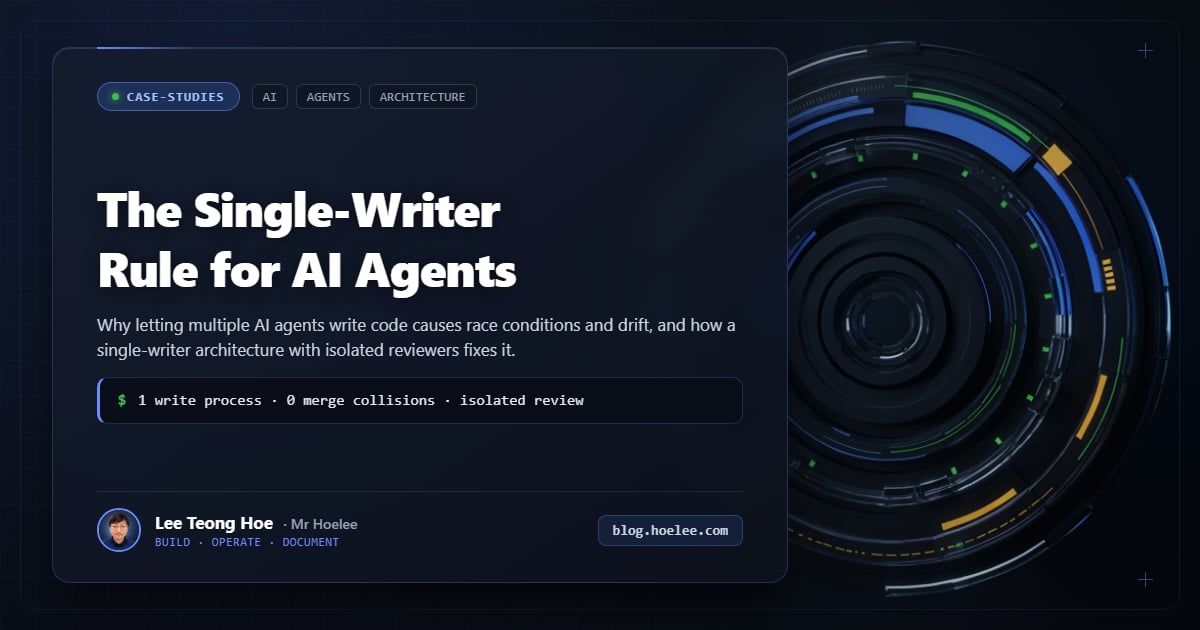
Restrict file writes to a single thread, use subagents strictly for read-only parallel work, and your pipeline will ship code reliably without the chaos. For a deep architectural breakdown and quantified production benchmarks, see: The Single-Writer Rule: Orchestrating Coding Agents Without Multi-Agent Chaos.
Want to Deploy Reliable AI Agents in Your Business?
I architect, build, and operate autonomous AI agent infrastructure, custom developer toolchains, and deterministic automation for teams looking to move past toy demonstrations:
- WhatsApp: +60 12-797 2969
- Email: [email protected]
- Website: hoelee.com