Shipping an AI Photo Editor as a WordPress Plugin: 22 Versions of Hard Lessons
A few weeks ago I wrote about the proof of concept: one
index.html, no backend, two furniture photos in, a staged room scene out. It
answered the question it was built to answer — can you keep the real product and
only generate the room around it? — and it left one obvious question open.
That PoC ended with the words “before committing to the full WordPress plugin.”
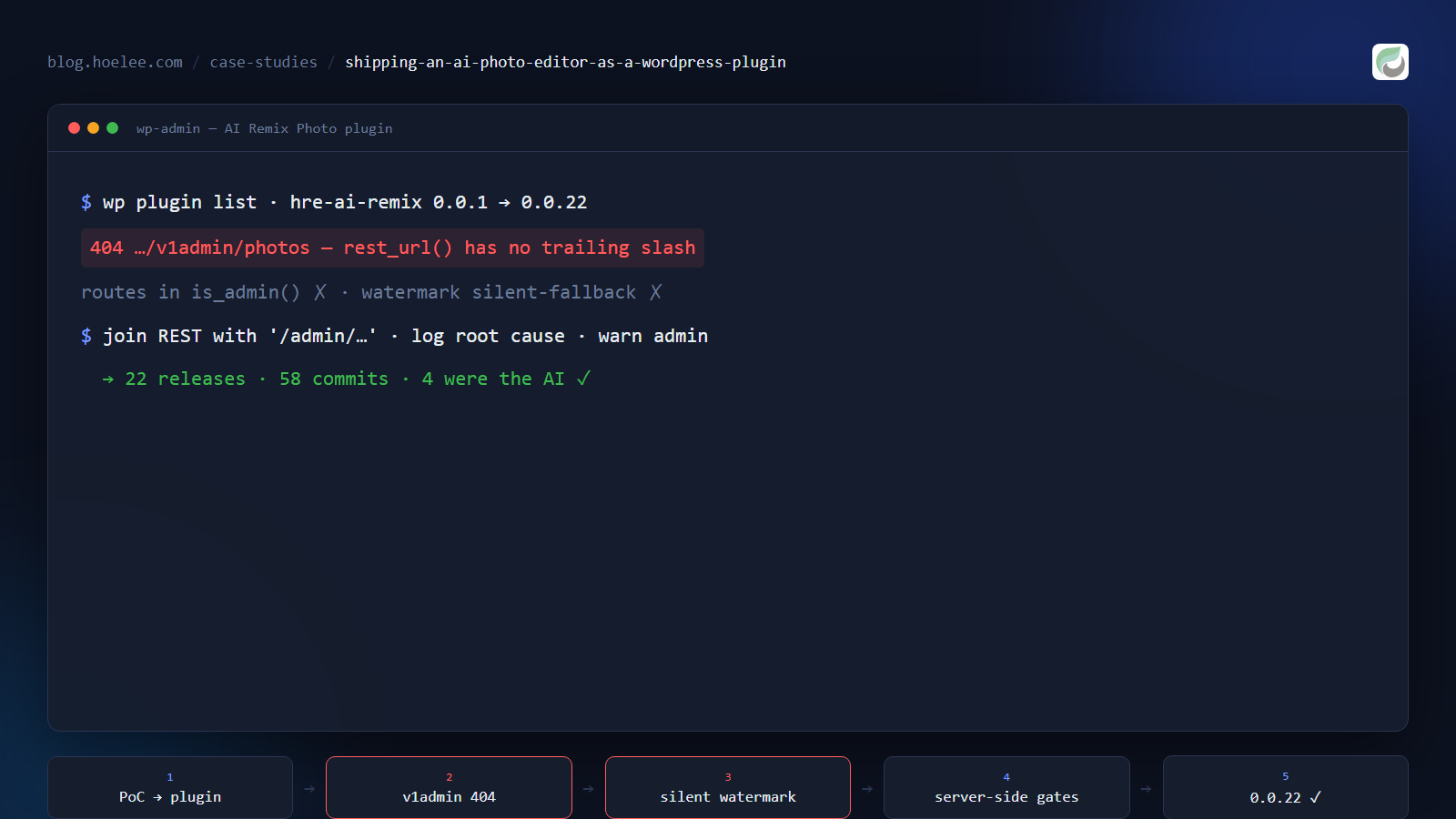
This post is about the plugin. It went from version 0.0.1 to 0.0.22 across 58
commits, and almost none of that work was the AI part.
Why it matters (for a business owner, not a developer)
The PoC’s limitation was that it lived in a single HTML file with the API key in the source. That’s fine for a demo you email a client. It is not fine for something a furniture shop puts on their own website, where:
- The API key cannot be in the browser. Anyone can view-source and drain your fal.ai credit. It has to live server-side, behind a settings screen an admin controls.
- Nobody wants to babysit a generation. The visitor uploads, waits, gets a picture. If the process dies halfway, the shop owner should never hear about it.
- Photos of customers must not leak. An anonymous visitor’s source photo must never end up in the public Media Library, and a result must never be public unless that visitor opted in to sharing it.
- Output needs a watermark. Otherwise you’re running a free AI photo service for the entire internet.
- The owner needs to capture the lead. An AI tool that produces a pretty picture and no contact details is a toy. Attached to a form + webhook, it’s a lead pipeline for a furniture business.
Every one of those five points is a product requirement, and every one of them cost more code than the AI call itself.
Architecture: the boring parts that make it work
The plugin is a normal WordPress plugin — PHP prefix hre_, namespace HRE,
custom tables created with dbDelta() on activation, an autoloader, no Composer
runtime dependency. The interesting decisions are elsewhere.
Generation is asynchronous, always
fal.ai jobs take 15–20 seconds. PHP-FPM request timeouts, max_execution_time,
and impatient visitors make synchronous generation a losing bet. So the flow is a
queue-and-poll:
visitor uploads  →  POST /uploads         →  normalize → start vision analysis
visitor picks    →  GET  /prompts/{cat}   →  per-style prompts
visitor confirms →  POST /jobs            →  fal queue submit (returns uuid)
browser polls    →  GET  /jobs/{uuid}     →  status: queued | processing | done
The visitor never waits on a provider. The job row carries the fal request id, and a poll either finds a finished result or shows genuine progress. The front end is a small state machine over a session cookie, so a mid-wizard refresh restores where the visitor was.
Ownership is the session cookie, not an ID in the URL
Anonymous visitors have no accounts, which makes authorization easy to get wrong. The rule I settled on: every read resolves through the caller’s own session hash, never through an ID accepted from the client.
GET /previewstreams the caller’s own normalized upload. There is no path or URL parameter at all — a stranger requesting it gets a 404 because their session has no file. This also keeps private storage paths out of every JSON payload.GET /jobs/{uuid}looks the job up by session hash + uuid. Guessing a UUID from another browser returns nothing.
That’s one decision that removes an entire class of “I changed the id in the URL and saw someone else’s photo” bugs.
The watermark is a hard requirement, so a fallback must never be silent
This is the bug that taught me the most. The watermark step does a GD
imagecopyresampled composite. If it ever fails, the tempting “resilient” move is:
// DON'T do this
if ( ! $watermarked ) {
    rename( $stage, $final );   // ship the un-watermarked file
}
I did exactly that. It’s silent, it has no log line, and it means the plugin happily serves un-watermarked results while the admin screen says “watermark: on.” The owner found out weeks later by noticing a photo without a watermark.
The fix was three parts:
- Log the root cause, not the nearest symptom.
apply()returnedhre_no_watermark_source— a downstream error. The real cause was that the watermark source resolution chain (site_logo→get_theme_mod('custom_logo')) had no logo to resolve. I added ablock_reason()diagnostic that re-walks the chain and returns a specific message per failure branch. - Surface it in the admin. A persistent
notice-warningsays the watermark is enabled but won’t be applied, plus the concrete reason. No log-reading required. - Make the failure visible to me in testing. A standalone probe composites a known watermark onto a known base and samples a pixel inside the expected watermark rectangle — proving the transform path itself works, which separates “the feature is broken” from “the feature is unconfigured.”
Rule I now follow: when a best-effort branch masks a non-negotiable transform, it must log the concrete reason and warn in the admin UI. A silent fallback that degrades a required feature is not resilience — it’s a bug with good manners.
Lead capture: off by default, asynchronous when on
Lead capture is a master toggle. Off, the plugin collects nothing and the wizard behaves exactly as before. On, the visitor’s configured fields are required before generation, stored in a custom table, and forwarded to a webhook.
Two decisions worth copying:
- The field list is admin-defined and fully dynamic —
{key, label, type, required, placeholder, options[]}— so the front form renders itself from config. The defaults (name, phone, email, message, consent) are just a starting point the owner can replace entirely. - Webhook delivery is scheduled, never inline. The visitor must not wait on someone else’s endpoint:
wp_schedule_single_event( time() + 5, 'hre_lead_webhook', array( $lead_id ) );Delivery retries three times with linear backoff, then marks the record failed.
The admin list shows a status badge (pending / retrying / delivered / failed) plus
the attempt count, and — this matters — the plugin’s data retention rule keeps
delivered leads but purges undelivered ones on the normal schedule, because an
undelivered lead is just PII sitting in your database.
The provider kill switch has to be enforced server-side
The admin can disable the image provider and set a message that visitors see instead of the generate button. Greying out the checkbox is UX; the enforcement is a check at the top of the job-creation endpoint:
if ( ! (bool) Settings::get( 'fal_provided' ) ) {
    return $this->error_response( 'hre_provider_disabled', $msg, 503 );
}
Same for the lead gate. The browser gate is UX. The server gate is the product.
The five bugs that only showed up in the real install
This is the part no article about “building an AI plugin” ever includes, and it’s where most of the 58 commits went.
1. Admin REST routes registered inside is_admin() silently 404
Registering admin routes only when is_admin() is true looks correct and is
completely broken: REST requests report is_admin() === false, so the routes
are never registered and every call returns 404 "No route was found matching the URL and request method" — which reads exactly like a URL typo, not a registration
bug. Register at plugin boot; the permission_callback (capability + nonce) is
what gates access.
2. rest_url() has no trailing slash
The one that cost me the most recent afternoon. rest_url() returns
https://example.com/wp-json/my-plugin/v1/ — the trailing slash is on the
namespace, and the next path segment must start with its own slash. Concatenating
without one:
const rest = window.hreAdmin.rest;      // ".../wp-json/hoelee-ai-photo-remix/v1"
fetch( rest + 'admin/photos/' + id )    // ❌ ".../v1admin/photos/123"
fetch( rest + '/admin/photos/' + id )   // ✅
.../v1admin/photos/123 is a 404 with no browser console error, so the
catch block fires and the UI shows the generic “Something went wrong.” It had
quietly broken four endpoints — photo pagination, photo delete, the webhook
test button, and lead resend. The fix is one character per call site; the
diagnosis took far longer, because the failure mode is indistinguishable from a
server error. Prove it with two curls: the correct join returns 403 (route
exists, nonce missing), the broken one returns 404.
3. A WordPress admin settings form can wipe a different tab’s settings
Each admin tab posts only its own fields, but the save handler runs the whole
settings map. A checkbox that isn’t submitted looks identical to a checkbox that
was unchecked, so saving the “limits” tab silently wrote false over the
“share by default” option, and saving that one cleared the entire lead-capture
configuration. The fix belongs in the sanitizer, not the forms — distinguish
“absent from this submission” from “present and empty”:
// present in this tab  → use the new value (a cleared field clears)
// absent from this tab → keep the current value
if ( array_key_exists( $key, $raw ) ) {
    $clean[ $key ] = sanitize( $raw[ $key ] );
}
I added a regression test for exactly this (seed config → save a different tab’s subset → assert the seed survived). It’s the kind of bug that only exists once you have two tabs, which is why it shipped.
4. A binary endpoint must not go through a JSON fetch helper
The result download is a JPEG stream. The shared api() helper did res.json()
on every response, which threw on image bytes — and a swallowing
.catch(function(){}) ate the error, so the symptom was “the result never shows
up” with nothing in the console. Blob endpoints need their own raw fetch helper
that checks res.ok, parses JSON only on error, and returns res.blob() on
success.
5. A size limit that fires before the resize defeats the resize
The plugin downscales uploads to a working size (1920×1080 bounds). I had set the decompression-bomb guard too low — 1 MB / 1 MP — which meant every legitimate phone photo was rejected before it could be resized. Visitors saw the preview appear and instantly de-select, reported as “the resize feature is broken.”
The real lesson is UX, not numbers: the client must reject an over-limit file before showing the local preview. Flash-then-disappear reads as a bug even when the message underneath is correct. The caps now sit at 15 MB / 50 MP, high enough that normal photos always pass and get normalized.
What I’d do differently
- Write the failure path first for anything the product depends on. The watermark bug existed because I wrote the happy path and then hid the unhappy one. Now I write the “what does the owner see when this breaks” branch before the feature is finished.
- Test REST joins against the live site on day one. A two-curl check
(
.../v1/admin/x→ 403 vs.../v1admin/x→ 404) would have caught four broken endpoints in week one instead of week four. I’ve added it to the project’sAGENTS.mdso it can’t recur. - Don’t guess at a provider’s API surface. I lost time on
fal.ai/api/me(which doesn’t exist) before discovering the right key check is an authenticatedPOST {}to the queue endpoint:401means rejected, anything else means the key is fine. Read the real schema, then write the client. - Keep the front end to two shortcodes. I was tempted to split the wizard into five shortcodes and five page-builder widgets. Keeping it as one app + one gallery shortcode meant every UI iteration was a single-file change, and that iteration speed is the reason 22 versions shipped.
The result
A production-shaped WordPress plugin: 0.0.22 across 22 releases, with 10
custom database tables, an async fal.ai queue, server-side key handling, dynamic
lead capture with a retrying webhook, a role-aware photo archive, and everything
configurable from a 10-tab admin screen without touching code.
It is the difference between a demo and a product, and — the number I actually care about — 58 commits, of which roughly four were about the AI model. The rest was the unglamorous work that decides whether a client can run the thing without me: validation, retention, permissions, failure visibility, and an admin screen that tells the truth.
Want this for your business?
I build WordPress plugins, AI image pipelines, and self-hosted infrastructure for Malaysian SMEs — and I ship them as products you can actually run, not demos you have to babysit. If you want AI product photography, a lead-capture pipeline, or a custom plugin for your business, I’d love to talk:
- 📱 WhatsApp: +60 12-797 2969
- 📧 Email: [email protected]
- 🌐 Website: hoelee.com