Self-Healing Access Control for Digital Goods: NocoDB, n8n, and AList
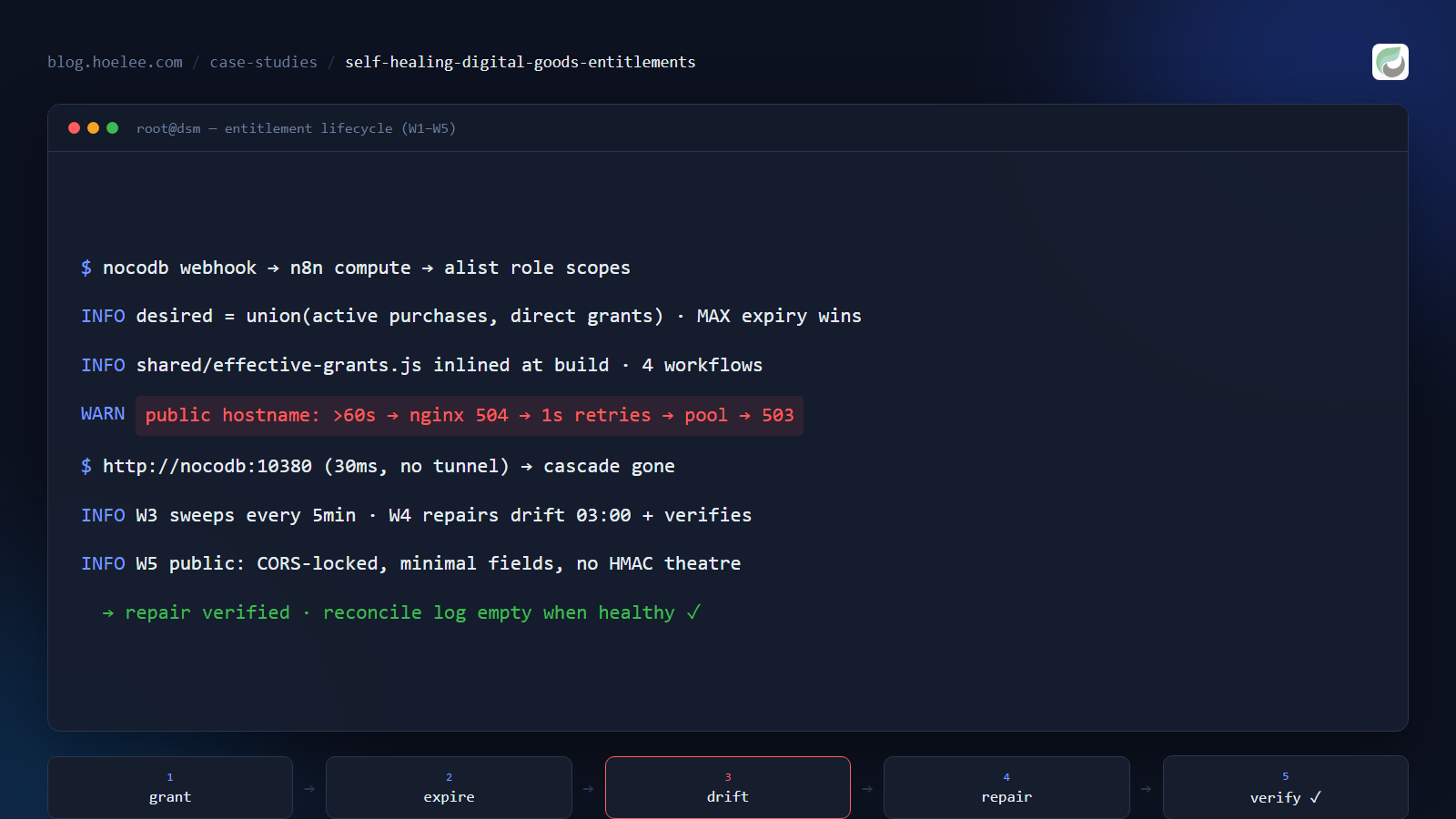
I sell digital products — files, artwork, licensed assets — and deliver them through a self-hosted file portal. The hard problem was never storage. It was entitlement: making sure that when someone buys, they get exactly the folders they paid for, for exactly as long as they paid for, and that when they stop paying, the access actually goes away.
Doing that by hand works for the first ten customers. It does not work for a hundred, and it fails in a specific and nasty way: silently. Nothing errors when a subscription expires and the customer keeps downloading. You just keep serving files to someone who stopped paying months ago.
So I built it as five n8n workflows that treat access as derived state — computed from my business database, applied to the file server, and continuously re-verified. Here’s the architecture, the code-sharing trick that makes it maintainable, and the security reasoning behind the one public endpoint.
Why it matters
For a digital-goods business, access control is the product. You’re not protecting a warehouse; you’re protecting the thing you sold. Two failure modes cost real money:
- Under-granting — a paying customer can’t reach what they bought, and you find out from an angry message rather than a monitoring alert.
- Over-granting — expired or revoked customers keep access, and the leak is invisible until someone resells your catalog.
Manual administration guarantees both, eventually. The fix is to stop treating a grant as a thing you do and start treating it as a function of your data: given the customer’s current purchases, what should they be able to reach right now? Compute it, apply it, and then prove it’s still true on a schedule.
The shape of the system
Five workflows, each with one job:
| Workflow | Trigger | Responsibility |
|---|---|---|
| W1 — Customer Provision & Status Lifecycle | NocoDB webhook (customer row) | Create/update the file-server user; enable or disable on status change |
| W2 — CustomerProduct Sync | NocoDB webhook (purchase row) | Recompute and apply that customer’s allowed paths |
| W3 — Expiry Sync | Cron, every 5 minutes | Sweep expiring entitlements; deselect paths that lapsed |
| W4 — Daily Full Reconciliation | Cron, 03:00 + manual webhook | Compare desired vs actual for everyone; repair drift; log |
| W5 — Footer Purchase Check | Public GET webhook | Let the portal show a customer their own purchases; read-only |
The data lives in NocoDB (a self-hosted Airtable-style database) as
Customers, CustomerProducts, Products, Resources, and AccessGrants. The file
server is AList, which gives each customer a user and a role whose
permission_scopes is a list of paths.
The crucial design decision: NocoDB is the business source of truth. AList is only enforcement state. Sync runs one way. A manual tweak in the AList admin UI is not a configuration change — it’s drift, and W4 repairs it back.
The algorithm: what should this customer have?
Everything hinges on one function. Desired paths for a customer is the union of two sources:
- Every resource reachable from an active, not-yet-expired purchase.
- Every resource granted directly via an active, not-yet-expired manual grant.
The interesting case is a resource reachable through two different products. If a customer bought Product A (expires in 30 days) and Product B (expires in 200 days) and both include the same folder, the correct expiry is the latest one — buying more of something should never shorten your access to it.
// For each product's resources, keep the MAX expiry per path.
for (const c of cps) {
  if (c.status && c.status !== 'active') continue;
  if (c.expires_at && String(c.expires_at) <= today) continue; // expired
  const pid = linkId(c.product);
  if (!pid) continue;
  const res = (await ncGet(ctx,
    `/api/v2/tables/${T_PROD}/links/${LNK_PROD_RES}/records/${pid}`)).list || [];
  const exp = c.expires_at;
  for (const r of res) {
    const p = resPath[r.Id];
    if (!p) continue;
    const cur = desired[p];
    if (!cur || !cur.expires || (exp && exp > cur.expires)) {
      desired[p] = { expires: exp || null, permission: cur?.permission ?? 0 };
    }
  }
}
Note the boundary: <= today. Expiring today counts as expired. Off-by-one
on an expiry check is the difference between a subscription period and a free
extra day, and if you’re not explicit about it you’ll get it wrong in the
customer’s favour.
The problem: n8n Code nodes can’t share code
Here’s the constraint that shaped the whole codebase. n8n Code nodes are
self-contained: there’s no require, no import, no filesystem access to a
shared module. So the obvious structure — one grants algorithm, called by W1,
W2, W3, and W4 — is exactly what the platform prevents.
Copy-pasting that function into four nodes would have been a guaranteed maintenance disaster. Four copies of an expiry rule is four chances for them to disagree, and a system that computes access four different ways is worse than no system.
The fix was to make the sharing happen at build time instead of run time:
shared/effective-grants.jsis the single source of truth, and it’s written to be self-contained: norequire, noprocess.exit, no top-levelreturnoutside a function. It also takes its config through actxargument ({ $env, helpers }) rather than reaching for globals — which has the happy side effect that it’s unit-testable outside n8n entirely.gen_w1.js,gen_w2.js,gen_w3.js,gen_w4.jsread that file, inline it into the workflow’s Code node body, and update the workflow.
The result is one algorithm, four workflows, zero runtime dependencies — and a version of the function that I can test with plain Node before it ever touches a live system. The code is duplicated in artifacts but never in sources, which is the same tradeoff a bundler makes.
One n8n-specific wrinkle worth knowing: custom environment variables are only
reliably readable via $env inside a Code node — process.env is not
dependable there. That’s why every workflow has an explicit “Load Env” node
that lifts the values it needs onto the item, rather than reading config
wherever it’s convenient.
Making expiry safe to automate
W3 runs every five minutes and reconciles expiring entitlements. Two details make it safe to let a cron job modify live access:
It only disables when access genuinely ran out. A naive “if no desired paths, disable the user” rule is dangerous — it will happily disable a brand-new customer who simply hasn’t been granted anything yet. The guard is explicit:
// Only disable when a customer that HAD scopes now has none.
// currentPaths.length > 0 avoids killing a fresh, not-yet-granted customer.
const shouldDisable = AUTO_DISABLE && nowEmpty
  && cust.status === 'active' && currentPaths.length > 0;
It has a dry-run mode. W3_DRY_RUN=true on the container (or a query
parameter on the manual webhook for W4) makes the sweep compute and report its
plan while performing zero writes. Being able to ask “what would you do?”
before letting a schedule do it is the single most useful safety feature I’ve
added to any automation.
const DRY_RUN = ($env.W3_DRY_RUN || '').toLowerCase() === 'true';The daily repair: assuming you’ll drift
W4 is the workflow I’d argue is the real product. It runs at 03:00, walks every customer, and compares desired state against actual state — then repairs the difference and verifies the repair.
The drift matrix it handles:
- Should be active → user must exist (looked up by username first, to avoid creating duplicates if a stored ID was lost), be enabled, and carry exactly the computed role scopes.
- Should be inactive → disabled, with scopes emptied. Pending customers stay without a user entirely — no auto-creation.
- Dangling references → a stored user or role ID points at a record that no longer exists. Look it up by name, adopt it if found, recreate if not.
- Username drift → detected and logged, never destructive-migrated.
Every repair is verified by re-reading the file server’s state afterwards. A
failed verification is logged as verify_failed rather than assumed successful,
and the reconciliation log only receives drift, repair, and error rows —
healthy customers produce nothing. That last choice is what makes the log
usable: if it’s empty, everything is fine, and you don’t have to read past a
thousand “no change” lines to find the one that matters.
The public endpoint, and why there’s no HMAC
W5 lets the file portal’s footer show a signed-in customer their own purchases and expiry dates. It’s a public webhook, and the security reasoning is the part I’m most deliberate about.
The obvious instinct is to sign requests with an HMAC. I didn’t, and the reason is worth stating plainly: the key would have to ship to the browser, so the signature would be theatre. A shared secret that every client holds protects nothing — it just adds ceremony that makes the endpoint look verified.
So the endpoint relies on things that actually hold:
- CORS locked to one origin. The response carries
Access-Control-Allow-Origin: https://drive.example.com, so only the portal’s own pages can read the response in a browser. - Minimal data by design. The response returns product name, expiry date, display state, and public folder paths. No internal database IDs, no customer PII, nothing about other customers.
- Rate limiting at the edge, via a WAF rule on the request path, to blunt username enumeration.
And one subtle architectural choice: the username comes from the caller’s own session token, decoded client-side, rather than from a parameter the client can set freely. The endpoint never authenticates to the file server, which avoids a whole class of connection state and device-registration side effects that a server-side login would introduce on every footer render.
The honest framing: this endpoint is not a trust boundary, and I don’t pretend it is. It shows a customer what they already know about themselves, over a response shape that’s useless to anyone else.
The bug that taught me the most: public path, cascading failure
W5 originally fetched data by calling NocoDB at its public hostname — through a Cloudflare tunnel. It worked in testing. Under real load it produced this chain:
- Public round-trip latency exceeded 60 seconds under load.
- nginx upstream timeout fired → 504.
- The footer’s client-side fetch had an 8-second timeout and retried every second.
- Retries piled up connections.
- Those connections exhausted the pool → 503 for unrelated requests.
A slow dependency became a cascading outage of a different service. The fix was to stop crossing the internet to reach something on the same Docker network:
// n8n and NocoDB share the `bridge_hoelee` network; NocoDB listens on :10380.
// The public route added CF-tunnel jitter and could exceed the proxy timeout.
const NOCODB_URL = 'http://nocodb:10380';
~30 ms internal versus 300 ms+ public, with no tunnel variance — and the entire failure chain disappeared, because the trigger condition (multi-second latency) can no longer occur.
The lesson generalises well beyond this stack: when a service and its dependency are in the same container network, the public hostname is a bug waiting for load. And when you see a 503 downstream of a 504, look for a client that retries aggressively — the retry loop is usually the amplifier, not the original problem.
What I’d do differently
- Build the drift repair first, not last. I wrote the grant path, then the expiry sweep, then the reconciliation. In retrospect the reconciliation is what makes the other two safe to operate, and it should have existed from day one — because “assume you will drift” is a design stance, not a feature.
- Write the desired-state function before any workflow. Having it live in
shared/and be unit-testable outside n8n is why the whole system stayed coherent across four workflows. If I’d started by pasting logic into nodes, I’d have shipped four subtly different expiry rules. - Never cross the public internet between two containers on the same host. This one cost me a genuine outage, and it’s a rule I now apply by default rather than discovering per-integration.
- Put the dry-run switch in from the beginning. Adding
DRY_RUNafter the fact was easy; operating a scheduled job that mutates access without one was an unnecessary few weeks of nerves.
The result
Five workflows run the full entitlement lifecycle: a purchase in the database becomes usable access within seconds, expiries sweep every five minutes, and a nightly full reconciliation repairs any drift and verifies each repair. The reconciliation log is empty when everything is healthy — which, most days, is what it says.
The design principle worth taking away is the one that made it tractable: stop administrating access, and start asserting it. Define what a customer should have as a pure function of your business data, apply that function whenever the data changes, and re-assert it on a schedule to catch everything else. Then the system doesn’t need you to be careful — it just needs you to be correct once, in one function.
Want this for your business?
If you sell digital products and you’re still granting file access by hand — or you’re not certain that expired customers lost access last month — I build exactly this: self-hosted entitlement systems where access is computed from your data, expires on its own, and repairs itself nightly. I work with NocoDB, n8n, AList, and Docker, and I hand it back documented so you can operate it without me.
Reach me at [email protected] or WhatsApp +60 12-797 2969, or see what I do at hoelee.com.