How I Self-Hosted a Mem0 Memory Stack (So My AI Agent Remembers)
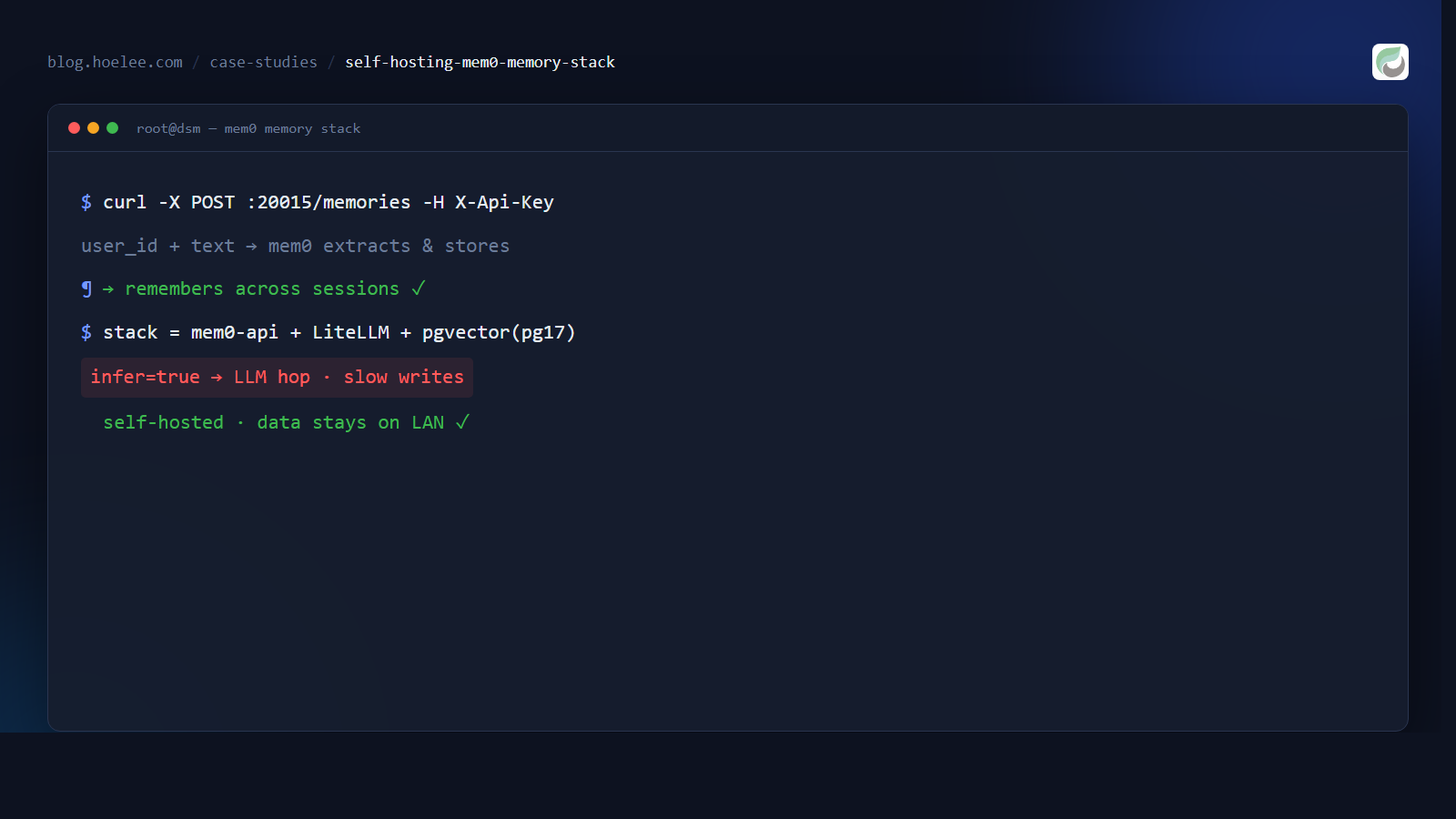
An AI agent that forgets everything between conversations is a tool you have to reintroduce yourself to every session. My AI assistant (the one that runs this very blog’s workflow) used to start each chat from zero — until I gave it a memory layer: a self-hosted mem0 stack that stores facts it learns, retrieves them semantically, and survives across sessions.
This is the story of how I self-hosted it on my Synology NAS — private, fully under my control, no data leaving my LAN.
Why this matters
A memory layer changes what an agent can actually do for a business:
- It stops re-answering the same questions. Remember a customer’s granted trial, their product, their last support issue — and the next conversation picks up where the last one ended.
- It makes “personalization” real. A bot that recalls your customer’s preferences and history is a bot that feels like a person. That’s not prompt-sugar; it’s a stored, searchable record.
- It keeps control of your data. Every “memory” I dislike about hosted memory services is solved by running the stack yourself — the facts live in my own PostgreSQL, on my own NAS, behind my own network.
For anyone running AI agents (support bots, research assistants, personal automation) the question isn’t should the agent remember — it’s whether the memory is a private asset or a third party’s.
What mem0 does
Mem0 is “memory in a box” for LLM apps. Instead of you hand-rolling an embeddings table and a similarity search, it gives you a small API that does the three things memory needs:
- Add a memory —
POST /memorieswith a fact or a conversation; it extracts, dedupes, and stores it (optionally classified by an LLM). - Search —
GET /searchwith a query returns the most relevant stored facts, ranked by semantic similarity. - User scoping — memories belong to a
user_id, so you can keep memory per customer, per project, or per conversation without cross-talk.
The “memory” is the extracted fact. The “retrieval” is vector similarity. You get the agent even if you never touch a vector database yourself.
The stack
Three containers on my Synology DS1821+, as a Portainer compose stack:
- mem0 API — the memory service itself (custom local build), listening
on port
20015. - LiteLLM — the LLM gateway in front of whatever model does the fact extraction. I can swap the underlying model without touching mem0’s config.
- PostgreSQL 17 + pgvector — the database.
pgvector/pgvectorbundles Postgres with the vector extension as a first-class citizen, so semantic search lives in the same DB as everything else.
┌──────────────┐      /search & /memories       ┌──────────────────┐
│ AI agent /   │ ──── X-Api-Key + JSON ───────▶ │  mem0 API :20015 │
│ Hermes / bot │                                └────────┬─────────┘
└──────────────┘                                         │ pgvector
                                                         ▼
                                             PostgreSQL 17 + pgvector
┌──────────────┐     model calls (extract)    ┌──────────────────┐
│ OpenAI etc.  │ ◀───────── LiteLLM ──────────│ fact-classifier  │
└──────────────┘                              └──────────────────┘
A representative compose looks like this:
services:
  mem0-postgres:
    image: pgvector/pgvector:pg17
    environment:
      POSTGRES_USER: mem0
      POSTGRES_PASSWORD: ${MEM0_DB_PASSWORD}
      POSTGRES_DB: mem0
    volumes:
      - ./data/pg:/var/lib/postgresql/data
    restart: unless-stopped

  mem0-litellm:
    image: ghcr.io/berriai/litellm:main-stable
    command: ["--config", "/app/config.yaml"]
    volumes:
      - ./litellm-config.yaml:/app/config.yaml
    restart: unless-stopped

  mem0-api:
    build: ./mem0-api
    environment:
      OPENAI_API_KEY: ${OPENAI_API_KEY}
      OPENAI_API_BASE: http://mem0-litellm:4000/v1   # go through the gateway
      MEM0_API_KEY: ${MEM0_API_KEY}                  # X-Api-Key for /search & /memories
      POSTGRES_URL: postgresql://mem0:${MEM0_DB_PASSWORD}@mem0-postgres/mem0
    ports:
      - "20015:8000"
    restart: unless-stopped
(Mine is built from the mem0 repo with the model/fact-extraction directed through LiteLLM; the exact image tag is me maintaining a local build, and I keep the real API key out of the compose file — it’s an env secret.)
Using it
Once it’s up, the API is refreshingly small. Add a fact (fast, verbatim):
curl -X POST http://192.168.1.1:20015/memories \
  -H "Content-Type: application/json" \
  -H "X-Api-Key: $MEM0_API_KEY" \
  -d '{
    "user_id": "customer-2211",
    "text": "Customer 2211 prefers email over WhatsApp for order updates."
  }'
Retrieve the most relevant memories later:
curl -X POST http://192.168.1.1:20015/memories/search \
  -H "Content-Type: application/json" \
  -H "X-Api-Key: $MEM0_API_KEY" \
  -d '{
    "user_id": "customer-2211",
    "query": "how should I reach this customer?",
    "limit": 5
  }'
Then inject the returned facts into the agent’s system prompt (or context) before it answers. That’s the whole loop: store facts, retrieve what’s relevant, use it in the next reply.
The infer gotcha that cost me a day
POST /memorieswith the defaultinfer=trueruns the LLM fact extractor — it classifies and cleans each memory. That’s smart but slow, and every call costs a model round-trip.- If I just want the agent to note something verbatim and fast (user said
“please call me Andy”), I pass
infer=false— no LLM hop, near-instant storage.
The route of my stack is /search and /memories without a /v1 prefix
(an early wrapper that assumed /v1 404’d for a while), and auth is a plain
X-Api-Key header. Small details, but they cost me time to discover.
What I’d do differently
- Set
infer=falsefor routine logging from day one. Only run the LLM extractor on the facts that matter; the default inference mode makes every write pricey for no benefit on throwaway notes. - Treat the API key as a real secret. It gets embedded in agent configs and compose envs, so I keep it out of the compose file and inject it via environment secrets.
- Put the DB on a disk I trust. Mem0 is only as durable as its Postgres. I run it on my NAS’s protected volumes, with a backup job — because a memory layer that forgets is worse than none.
The result
A private, self-hosted memory layer answered by two small HTTP calls. My agent now remembers customers, preferences, and decisions across sessions — and because the stack sits in my own PostgreSQL behind my own network, none of that leaves my control.
If you run AI agents that keep forgetting their context, self-hosting mem0 is one of the highest-value, lowest-friction upgrades you can make — and you can do it without sending your memory to someone else’s database.
Want a memory-enabled AI setup for your business?
I build and self-host AI agents, memory stacks, websites, and infrastructure for businesses. If you’d like your assistant to actually remember your customers — or you want to talk about hiring me — I’d love to help:
- 📱 WhatsApp: +60 12-797 2969
- 📧 Email: [email protected]
- 🌐 Website: hoelee.com