Syncing a Self-Improving AI Agent Across Machines
My agent learns. Every time I walk it through a non-trivial workflow — how to publish to Gitea, how to troubleshoot a flaky Docker container, how to write a Shopee listing — it saves that as a skill: a reusable procedure it loads the next time the task comes up. Over a few months that grew to 172 skills across twenty categories. They’re my second brain.
The problem: that brain lives on one machine. When I sit down at my other PC, the agent is dumber — it doesn’t know what I taught it on the first one.
This is the story of how I made the agent’s knowledge follow me between machines, why the obvious approach would have silently destroyed work, and the one decision that turned out to matter most.
Why this matters
If you run any self-improving agent — Hermes, Claude Code, Codex, Cursor — you have this exact problem. The agent accumulates knowledge locally, and none of it moves. You either re-teach it on every machine (pointless) or you let the two copies drift until they contradict each other (worse).
Solving it properly means three things, and they’re the same three things any engineer cares about when syncing any state:
- A shared source of truth — one canonical copy both machines pull from.
- No silent data loss — a sync that can’t clobber work you did on the other machine.
- A decision point — when two machines changed the same thing, you pick, not the tool.
Get those three right and your agent is genuinely the same person on both
machines. Get them wrong and you spend a weekend reconstructing a skill a bad
--force wiped out.
The three official mechanisms
Hermes ships three ways to move an agent, and they answer different questions:
| Need | Mechanism | Command |
|---|---|---|
| Just skills | Skills Hub “tap” (a git repo of SKILL.md folders) | hermes skills tap add + install |
| Whole agent, versioned, pullable | Profile distribution (git repo + distribution.yaml) | hermes profile install / update |
| One-off move / backup | Export file (.tar.gz) | hermes profile export / import |
For “same agent on two machines,” the profile distribution is the durable answer. It packages the whole agent — SOUL, config, skills, cron — as a git repo, and the other machine pulls updates with one command.
I already run Gitea (git.hoelee.com) for everything else, so a distribution repo there was the natural fit. No new tooling, no new accounts, and it plays by the same Gitea-first convention I use for every project.
The trap I almost walked into
The distribution installer has a safety property that sounds like a
limitation but is exactly what saves you: it refuses to install into the
default profile. You must give it a named profile.
That’s not an annoyance. The second PC already had its own agent with
project-specific skills. If I’d installed the distribution over it — or used
--force, which overwrites an existing profile — I’d have deleted that
machine’s local work. The default-refusal is the guardrail that forces you to
install alongside the existing agent, then merge.
Which is the real lesson of this whole exercise: the merge is the product. The sync isn’t “copy files.” It’s reconciling two agents that both think they’re the source of truth.
The layout fact that would have clobbered me
Here’s the subtle part, and it’s the kind of thing that looks fine until it isn’t.
The distribution repo holds a copy of the skills tree — it is not the
live directory. The live skills live in ~/AppData/Local/hermes/skills/ (where
the agent actually writes); the repo copy is a snapshot I push. They are two
separate trees that drift.
So a sync actually has three parties, not two:
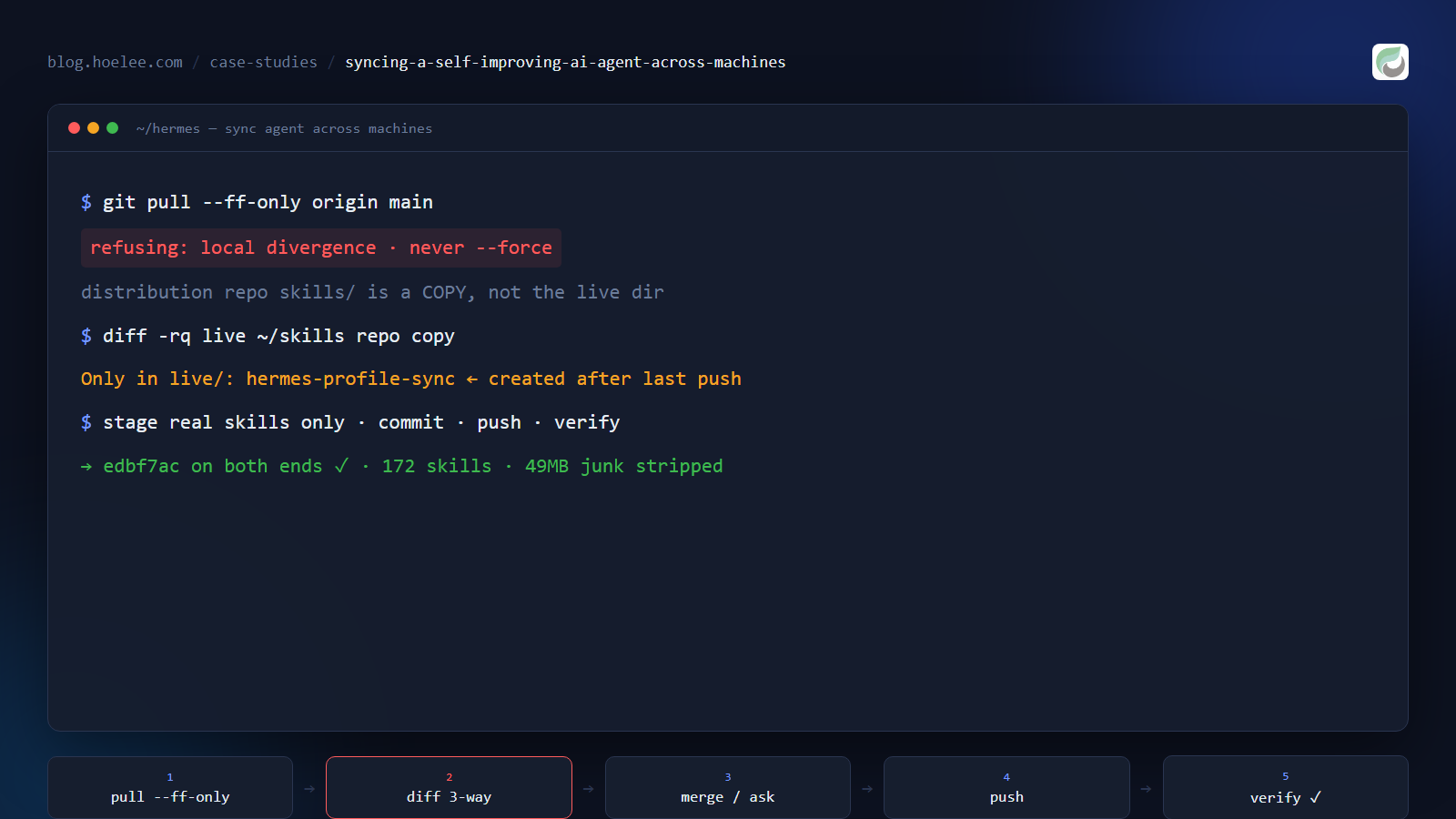
live skills dir ←→ repo copy (D:\dev\hoelee-agent-dist\skills) ←→ Gitea remoteA skill I create after the last push exists only in the live dir. If I’d assumed the repo copy was authoritative and “synced” from it, I’d have silently deleted that skill. The first thing I do before any sync is diff the two trees:
diff -rq ~/AppData/Local/hermes/skills D:/dev/hoelee-agent-dist/skillsDivergence is normal, not an error. The whole discipline is knowing which of the three parties is ahead and reconciling deliberately.
Why I sync manually, not on a cron
This was the decision that mattered most, and it came down to the conflict policy. I want two-way sync — both machines edit skills — and when both edit the same skill, I want to keep both and pick myself, not have a tool silently drop one.
That policy is inherently interactive. A cron job that auto-pulls either overwrites work or fires when I’m not looking. So I made the trigger manual: I say “sync skills”, the agent runs it, and it stops and asks me on any conflict. It’s not laziness — it’s that the merge decision is mine to make, and automation can’t make it for me.
The flow I documented (and now run) is:
# 1. Pull remote into the repo copy, fast-forward only — never force
cd D:\dev\hoelee-agent-dist && git pull --ff-only origin main

# 2. Reconcile live dir ↔ repo copy
diff -rq ~/AppData/Local/hermes/skills D:/dev/hoelee-agent-dist/skills

# 3. Stage only real skill content (never the curator junk)
# 4. Commit + push, then verify the remote actually has it
git ls-remote origin main   # must match local HEAD
If the pull refuses, or a diff shows the same skill changed on both sides, I
stop and decide. Never --force, never a reset.
The junk that was silently bloating the repo
One concrete number from the first packaging: my skills directory was 57 MB, but only ~8 MB was actual skill content. The rest was runtime state the agent’s curator writes constantly — a 40 MB hub index cache, curator backups, usage tracking, a ledger.
None of that belongs in a shared repo. It changes daily, it’s machine-local,
and it would have made every sync a noisy mess. A .gitignore strips it:
# skill runtime junk — never ship
skills/.hub/
skills/.curator_backups/
skills/.curator_ledger.jsonl
skills/.usage.json
skills/.bundled_manifest
The moment you package a self-improving agent, you discover it’s not just
files — it’s files plus a layer of bookkeeping you have to keep out. Same
lesson as a .gitignore for node_modules, but for your own memory.
What I’d do differently
- Think about the trigger before the mechanism. I spent effort deciding distribution-vs-export before I’d answered “do I want this manual or automated?” — and the answer to that question changed the mechanism. If I’d known I wanted manual, conflict-aware sync from the start, I’d have designed the script that way on day one.
- Treat the copy-vs-live distinction as a named invariant. I discovered it
by diffing; it should have been a line in my notes from the first
cp -r. - Decide per-machine
user_idup front for memory. Skills sync via git, but episodic memory (mem0) is a separate backend — two machines either share one memory bucket or keep separate ones, and that’s a one-line config choice I should have made explicit earlier.
The result
I now have one git repo — git.hoelee.com/hoelee/hoelee-agent-dist — holding
172 skills, my config, SOUL, and cron jobs. The other machine installs it into
a named profile, merges its own skills in, and we stay in sync with a manual
trigger that asks me on every conflict. The first real sync pushed a
skill that existed only on the live machine, verified it landed (edbf7ac on
both ends), and left every existing skill untouched.
The honest takeaway for anyone syncing an agent: the files are easy — git
does the heavy lifting. The hard parts are the guardrails: the --force you
must never run, the copy you must never mistake for the source of truth, and
the conflict you must never let a tool resolve silently.
Want this for your own agent setup?
I build self-hosted AI infrastructure — agents, bots, and automation — for businesses and individuals. If you’re running an agent across machines (or want to start), or need a hand with self-hosted tooling, I’d love to talk:
- 📱 WhatsApp: +60 12-797 2969
- 📧 Email: [email protected]
- 🌐 Website: hoelee.com